VULNUS
A New Concept of Continental Evolution
The Short, Conversational, Version
It is only during the last few hundred years that Mankind has devised or discovered the necessary tools to help him understand his “place” in the universe (via telescopes, photography, radar, sonar, satellites, etc.). We now even understand that our “place” is a mobile solar system, within a moving galaxy! – But, we have also learned that there are physical laws of light, mass, and motion that seem to remain constant across the universe.
When early Humans first acquired curiosity and an Ego, it is probable that they wished to know where they stood in relation to their celestial surroundings, maybe even as much (or more?) than they wished to know where they stood with other Men. They could not yet discern the Earth’s motion in relation to the heavens, but the motion of the stars and other astral events would be a predictable part of most night-time discussions around the fire. A person who knew the rotation of the stars, could learn to anticipate the changing of the seasons… (And it was easier to remember the annual return of certain stars if you could group some them into patterns).
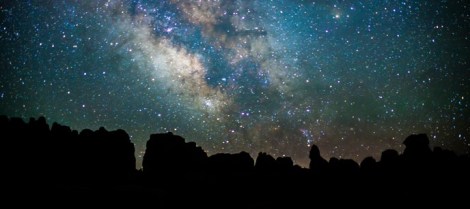
We, as cognitive Humans, have been standing around evening camp-fires, and looking up, for hundreds of thousands of years, at least until street-lights began to wash-out the night sky about a hundred years ago!
And, you can be reasonably certain that there were at least as many Humans looking down at the ground, as there were looking up at the stars.
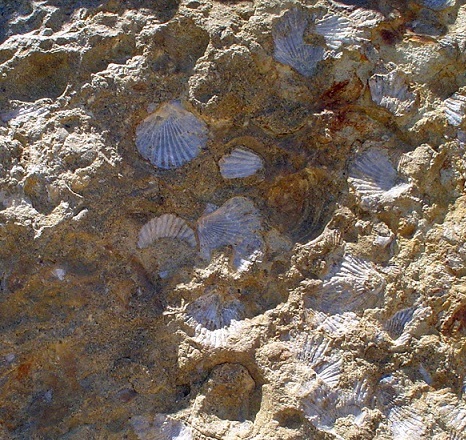
Some of those earlier men, because they found seashells high up on mountain slopes, concluded that there must have been great floods that had covered the earth at one time! It wasn’t until the last few hundred years that geologists finally figured out that land masses had the ability to rise; Not just a little, but given enough time, actually miles above sea-level. It was also about then that they determined that the Earth and our celestial neighbors were very, very old.
How old the Earth is, and how it came to be, are questions that are still in the hypothetical stage. It is hard to discern the facts when there are no witnesses.
There are theories that Earth started as a large solid mass, floating for billions of years alone in space, only to be ultimately grabbed by the Sun’s gravitational field and sucked into the inner circle of our small solar system; and others that surmise that “It always has been, and always will be…”
A majority of scientists proscribe to a hypothesis called accretion, which says that large enough space-rocks will start to gather smaller ones, continually gaining mass and increasing their gravitational pull – and, over time, many of these growing “planets” will get large enough to become spherical and acquire an atmosphere. I imagine that one of the problems is in having enough small rocks around for the big rock to gather in the first place. There needs to be quite a bit of “gravel” in the vicinity, or the planet size is limited.
Whatever theory you choose, geological carbon-dating and other techniques have narrowed the Earth’s age to about 5.5 Billion years old.
And also, there is the fact that we have a moon!
Why is it there? Why is it always facing us? How long has it been there? And, what is it made of? What is its historical relationship with Earth?
The last few decades have brought great strides in coming closer to those answers, but most of the “answers” are still theories (just like those regarding the Earth’s formation) – although some are better, more plausible, or more acceptable than others.
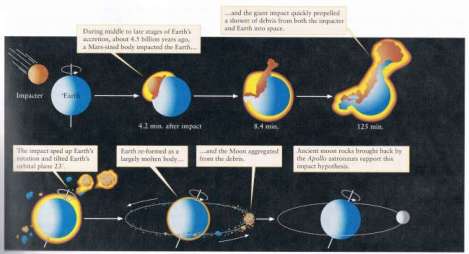
In this paper, I adhere to the set of theories which regard the Moon as a spin-off from a collision between the Earth and another foreign space object that, for whatever reasons, already had a similar geological make-up to our Earth.
The Vulnus Theory attempts to follow the moon/collision theory through one of its many naturally viable conclusions – to that of a single plate “Pangaea” on top of an otherwise all-encompassing thin oceanic crust.
So,
Here is Earth – or more accurately, Proto-Earth about 5 Billion years ago. It is sitting in the vast darkness of space. A small, but very hot ball of accreted rock and space debris.
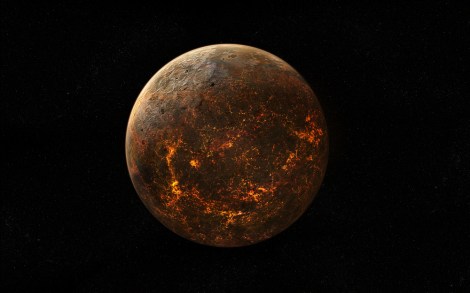
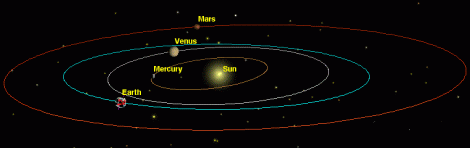
It inhabits an area relatively near a “brother” planet we now call Mars. They, with a family of seven or eight others have spent the last few billion years attached (gravitationally) to, and following, an old yellow star around the outer reaches of a galaxy called the Milky Way.
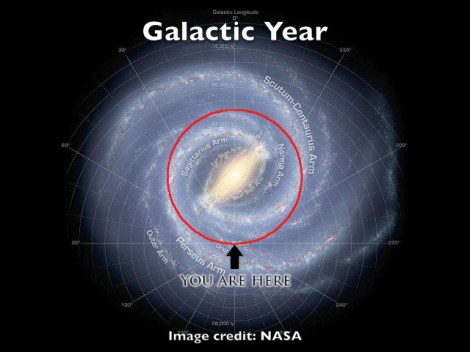
The Milky Way spins like a pin-wheel, such that proto-earth, and the billions of other celestial bodies that inhabit it, make a perpetual 225 million year journey around the central core. A carousel ride in which our own Solar-system is merely one of the many millions residing in the arms of the spiral.
The little, crusty, hot, rock that will someday become Earth, spins on its merry way – oblivious to its place in the universe, and oblivious to what is about to happen…
Then – BOOM!!! The World is changed. At least, for the little rock that will eventually become our Home!
Somewhere between 4.5 and 3.5 Billion years ago, Proto-Earth was rammed!
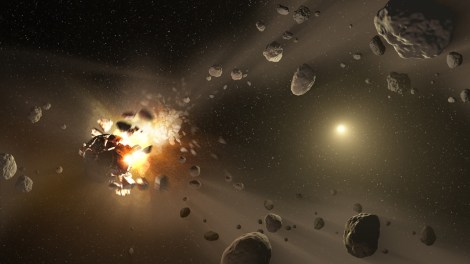
Another planet, or asteroid of similar composition to Proto-Earth, and about one-third its size, slices right through in a HUGE fireball.
The cataclysmic momentum drives Proto-Earth slightly away from the Sun…, just enough that it eventually comes to rest in a moderately cooler temperature zone.
But, the event was so big it didn’t just move Earth – it also “birthed” a Moon.
A small part of Earth, and or Theta (the name that most current theories use for the object that struck Earth), was scraped from the depths of their merged cores! This “baby” rock was born out of a mix of devastation and minerals. And, ironically for Earth, this huge new piece eventually came to rest only about 225,000 thousand miles away – fully visible almost every night, and forever facing it with a sad face of wounds, and injury.
For the next few billion years, this “Mother” Earth, and her broken “child”, the Moon, gather the loose space debris into their respective gravitational fields – Until they both eventually “settle” to their respective sizes and their beautifully spherical shapes.
However… what about this massive scar on the surface of Earth? After all, it was just rammed hard enough to lose a large quantity of surface matter – does a canyon the size of the moon just vanish?
Earth has suffered the huge injury of a deeply cracked crust, and its hot magma leaks out over the thin, but cooler, and relatively stable outer crust.
Here, I introduce Vulnus: Latin for a wound, a cut, misfortune, calamity …disaster.
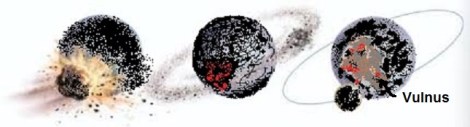
From the bowels of proto-Earth, magma and other materials migrate to the surface to fill the void. And, over the course of billions of years, the mantle under the wounded crust “heals” itself as molten rock fills the canyon. Also, as time passes, the surface crust cools again – but the scars of the “Moon-birth” remain.
Now though, because of this great collision, a brand new piece of terra firma (a “scab” composed mostly of granite!) covers about 25% of Earths land-mass!
At some point, maybe around 2 billion years ago, water arrives at our planet – Either from an asteroid or some other celestial event – but water shows up, and life begins. And for unknown reasons, the newly acquired water does not entirely cover the new land surface, but leaves much of it exposed to the quickly forming atmosphere. Over time, granite and basalt break down into “dirt”, and relatively soon a desert landscape forms on the parts of land that remained above water.
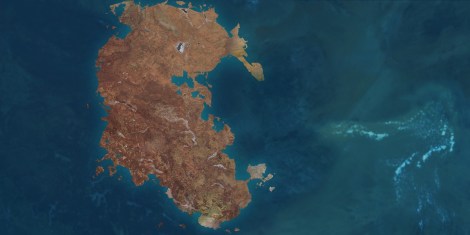
And Vulnus, not Pangaea, is that new, huge, continent that has appeared on this planet.
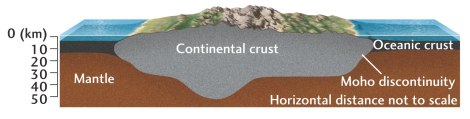
Vulnus is much like a huge, unfinished granite counter-top… And just as Fragile.
It is the very same world that Alfred Wegener envisioned a hundred years ago, But, while Pangaea was considered to be an accumulation of island continents drifting on their own established “platters’ – Vulnus is a single, fractured, Granite plate with varying degrees of thickness, but mainly unbroken.
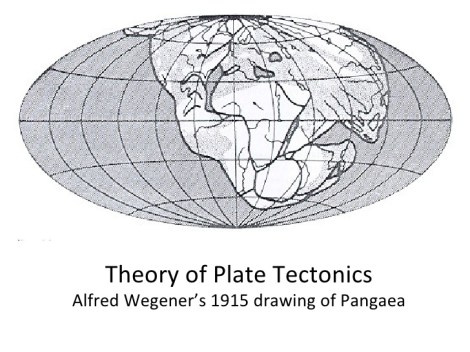
Here, I will point out that there are many other theories regarding the formation of Pangaea. The most widely accepted ones suggest that there were prior “islands” of granite that were pushed and pulled around the earth by subduction and sub-surface magma currents. These islands eventually were “moved” into the Pangaean configuration sometime before 300 million years ago. I have a side-question as to whether or not oceanic water is necessary for this version of plate tectonics. Would the “islands” move about as easily on a dry surface – if water has not arrived yet?
***
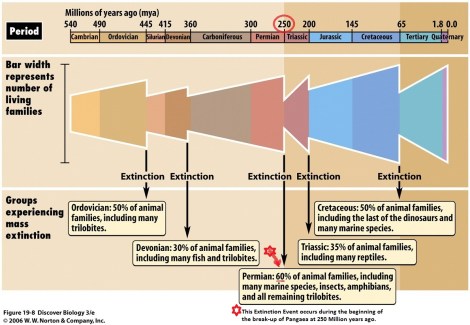
No matter who’s theory, all remains calm (once again… relatively) until about 250 million years ago.
Then, there are many, many theories about what happens next, but the main gist of the consensus thought is that a LARGE subterranean magma event occurs. Subduction events cause the Mid-Atlantic Ridge and other areas to open up to fissures and super-volcanoes! The Ridge begins to ooze lava material, and the continents of North and South America start to spread slowly away from those of Africa and Western Europe.
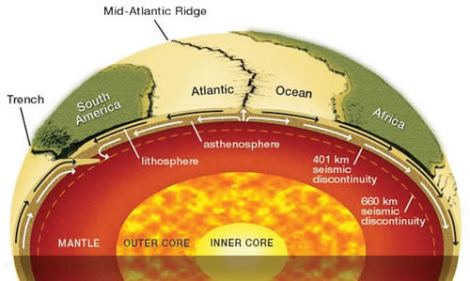
I, of course, have a slightly different view of the break-up of Vulnus.
In my “creation theory”, a large object strikes Vulnus. Its size, speed, and density are such that it creates the Caribbean plate – which at that time resides right up next to what will become Mauritania, Africa. The strike is slow and angled – with such a mass that it sinks into the mantle almost immediately.
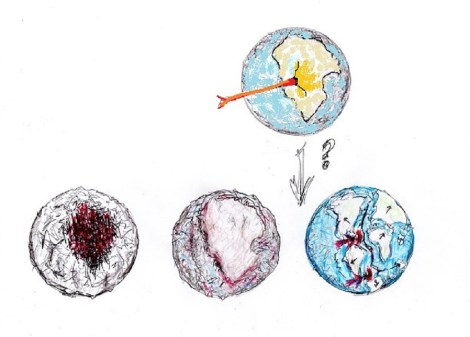
Most meteorites have been described to me as hitting the Earth “like a hot knife through butter”, I propose that this one was different!
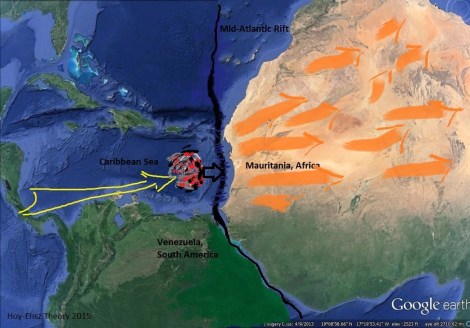
This one cracked the granite plate, and mantle, deep enough to create the Mid-Atlantic Ridge. And from that event, all plate tectonics follow as current geology sees them.
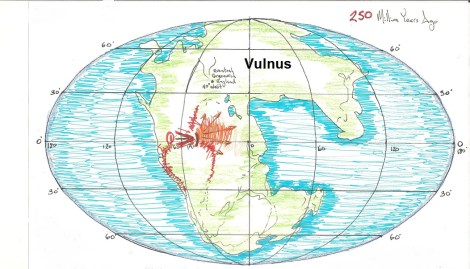
Such a large event should have triggered a major extinction event: And it did.
And as to the further break-up of Vulnus – I have a theory regarding that event as well. But that is a different discussion.
Or check-out www.paleo-opolis.com/gondwana and
 Paleo-opolis