Or
Why are you calling my sandwich a dessert?
Our American diet has deep roots in beef and wheat, but I am going to address just the wheat in particular for a few minutes. Wheat (and other grains) are at the base-level of the Government approved Food Pyramids. Wheat is a large part of our farming economies, not nearly as much as corn has become (for different reasons than wheat), but it remains a major export crop and there is still enough wheat paste left over to dominate your local grocery store aisles. Think: pasta, pizza, breakfast cereal, pancakes, waffles, cookies, cakes, hamburger buns, hot-dog buns, the bread wrapped around any sandwich you have for lunch, dinner rolls, donuts, and on and on… Corn and rice are similar in their nutritional make-up to wheat, but since this is a look at the American diet, wheat is a more than adequate representative seed.
We are a country that gained its roots from European farmers that immigrated over in the 1600 and 1700’s, and there seem to be a majority of Americans that think of wheat as THE basic ingredient of the Human diet. Wheat, in the form of bread, has been heralded as a Super-food, a saver of civilizations, and Manna from Heaven. But I’d like to swim upstream, against the marketing for a minute.
First, let me establish what wheat IS, – both nutritionally and chemically (in understandable terms). Wheat is a seed – and as a seed, it consists of 2 parts we consider edible: 1) the germ – the little part of the seed that will grow into a new plant, and 2) the endosperm – the part of the seed that is intended to be used as food for the little shoot of wheat as it grows into its new surroundings. For wheat (and most other seeds) the germ is mainly PROTEIN, and usually consists of about 10-15% of the seed. The endosperm is STARCH, which is a botanical term for stored sugar, and it makes up about 80% of the seed. The current Marketing term for this stored sugar (other than starch) is the word – Carbohydrate. And, if you look up the word carbohydrate in the dictionary (or even on the web – and you should look it up) you will find that it is the chemical definition of SUGAR. A carbohydrate is the combination of Carbon and Water (Hydrogen and Oxygen) into a chemical SUGAR chain. There are various combinations of sweetness and taste to the many sugars that can be created (wheat sugar is pretty bland), but to our pancreas and muscles they are all pretty much the same if ingested.
It matters to our pancreas because it’s the organ that is charged with eliminating excess sugar when it enters the body. What is excess? If you use a glucose (blood sugar) monitoring system, you know that a reading of about 90 mg/dL is generally considered to be a base-line for the sugar content of our blood. Since we have about 5 Liters of blood in our bodies on average, 90 mg of sugar in 5 liters of blood works out to 4.5 grams of sugar as being the NATURAL, and normal of amount of sugar in our blood. Your pancreas would be in agreement. Now, 4.5 grams of sugar is just about ONE teaspoon. So, if you add a teaspoon of sugar to your coffee, you have just doubled the amount of sugar in your blood! If you drink a soda with 8 teaspoons of sugar in it, your body has to “fight” to try to eliminate everything above that NORMAL 4.5 grams.
Your pancreas goes to work to try to find “home” for all that new “energy”. It directs as much of the sugar as it can to your muscles (note: not any one particular muscle, or group – just ALL of them at once), it sends some to your kidneys to be peed out, and the rest it tries to store for later use – after all, it IS energy. The sugar-mitigation process takes about 2 hours, and at the end of it your blood sugar reading should be back to about 90. This is what the Pancreas does. But, every bit of sugar that couldn’t be used or expelled – is now residing somewhere in your body as FAT, either on your organs, or around your waist and limbs.
But we were talking about Wheat, not coffee and sodas, so let’s look at the nutritional label on a few different types of bread. And let’s pay attention to the WEIGHT, not the “% of Daily Balances” (for reasons to be discussed later *):
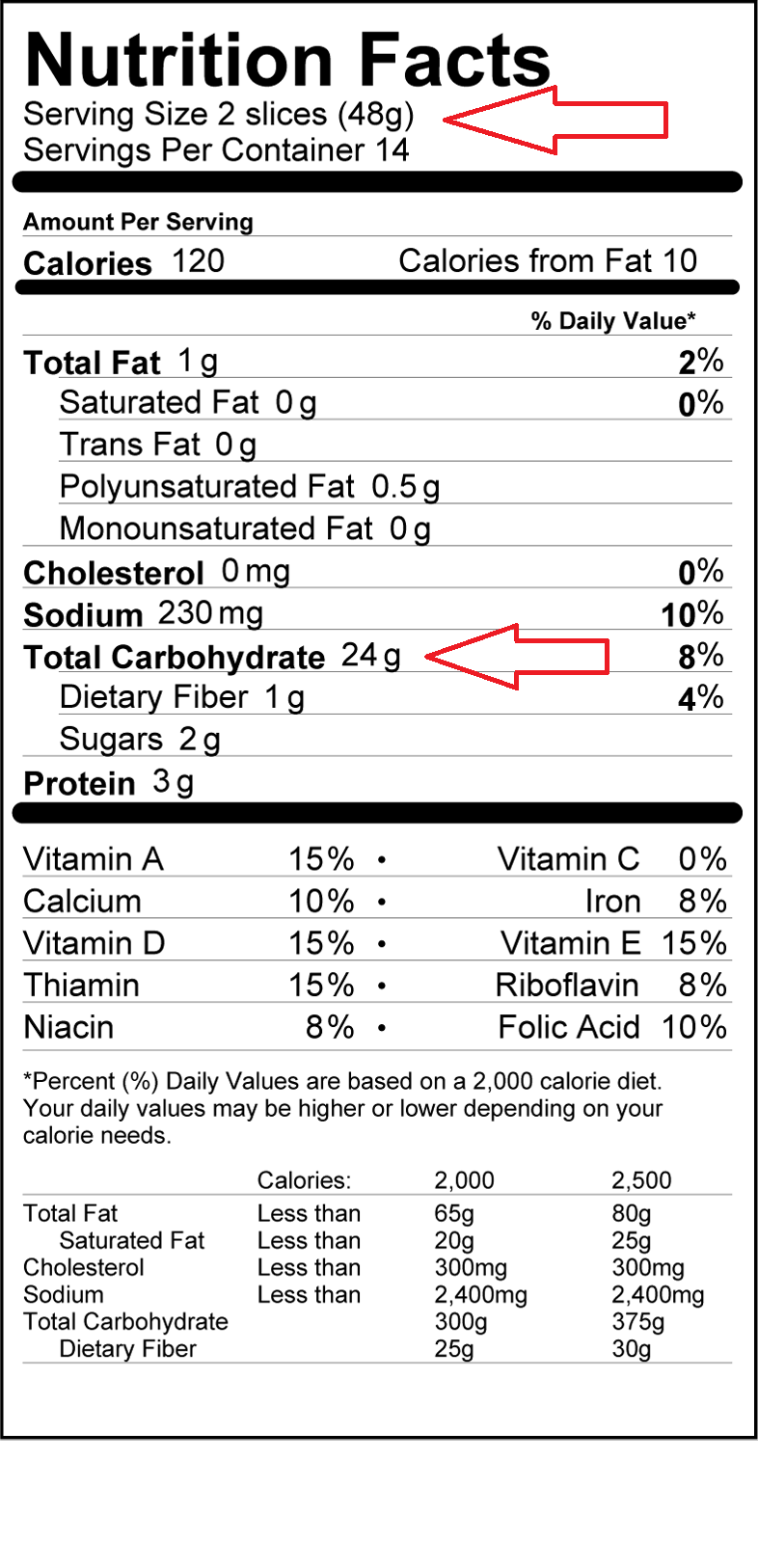
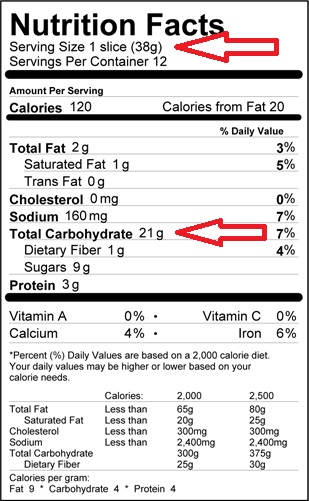
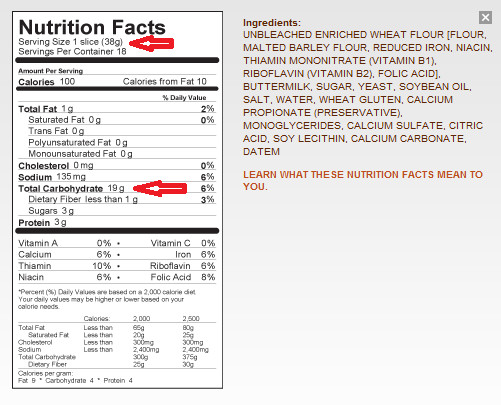
Bread labels now show grams per slice (or 2 slices) which helps make this easy. The average slice of bread (white or wheat) seems to hover around 30-35 grams. And in almost every case, the nutritional break-down is into 3 major categories 1) FAT (saturated or trans) – which is usually only a few grams, if any 2) CARBOHYDRATES (which we now know, by definition, is SUGAR) – usually at least half, or a little more, of the weight at 15-20 grams (note: if SUGAR is shown as a separate line item, it is the sugar ADDED during the baking process for a sweeter taste), and 3) PROTEIN – which generally runs at about 1%, or less, of the total weight – maybe 2-4 grams.
This ratio spreads across the boards to almost all grain products. Check some labels – please.
Back to bread – The loaf I bought (enriched White Sandwich) had 17 grams of Carbohydrate (SUGAR) in a single 34 gram single slice. This slice of bread is exactly HALF sugar – and only 1% protein (3 gms). This slice of bread is about the same ratio of sugar to protein as in waffles, breakfast cereal, pizza, pasta, buns, cookies, and on. They are all about half, or more sugar by volume.
Here’s the scary part – that single slice of bread, and its 17 grams of carbohydrate, equates to a little over 4 teaspoons of SUGAR (17 gms / 4 gms = 4.25). Two slices of bread, one on each side of some ham, would be like eating the ham with a “side” of 8 teaspoons of sugar. Imagine feeding such a meal to your child and calling it healthy!
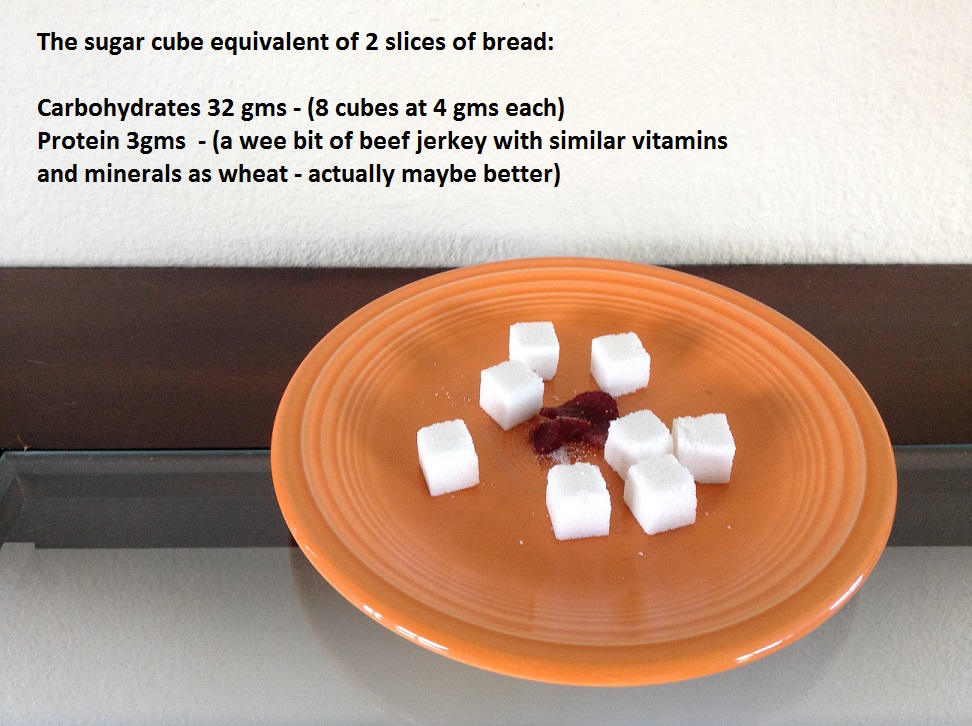
Second, let’s establish whether wheat or bread is a basic food group:
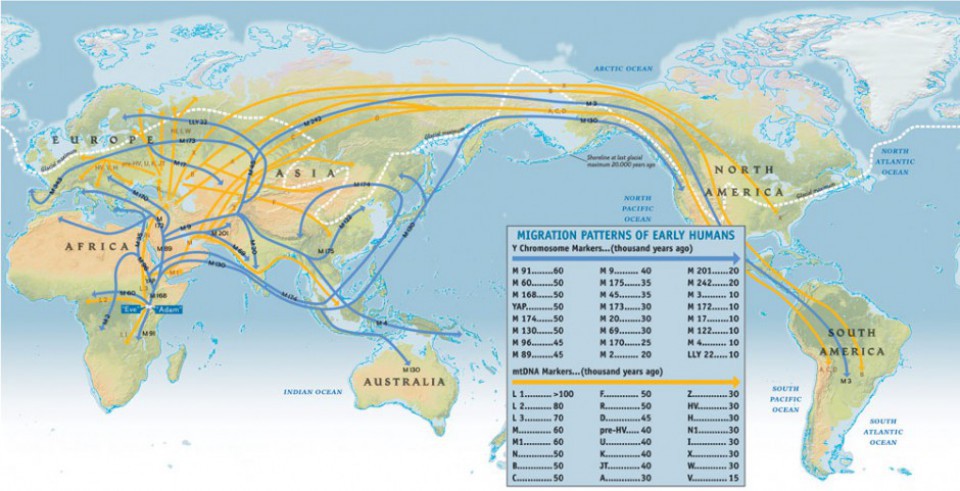
Imagine any one of your ancestors from about ten thousand years ago (or earlier), and place them in whatever you would consider their natural environment at that time. They would have been hunters and gatherers then, just like mine; and for most of us, they would be living in an environment that had fresh water, game animals, reasonable vegetation, and 4 full seasons of weather to mitigate the availability of all of those things. As far as science can tell, no one at that time was eating, or grinding grass seeds for use as a consistent dietary supplement – yet.
At ten thousand years ago, the men and women who were living in Europe and Asia were chasing game throughout the year – although it was much harder in the winter, and they were eating vegetables, tubers, berries, fruits, and nuts whenever they could be found. What is clear is that the availability of everything other than meat, would have been near to ZERO every winter – and probably pretty sparse for much of the remainder of the year. Vegetables, berries, fruits and nuts are all SEASONAL (at least until supermarkets evolved).
So the truth is that all of your ancestors, for hundreds of thousands of years – even millions! – have had a tentative, important but tentative, relationship with all food other than meat (in the form of fish, foul, and beasts). Our shared evolution is one of feast and famine, the hunt, and the dietary realities of winter.
Sugar, through the advent of wheat farming, did not have the opportunity to become a mainstay of our diet until around 8,000 years ago in the mid-East, and much less time in the north and far-eastern reaches of the Human migration.
A few observations:
- It is important to remember that your liver CREATES sugar (glucose) when you drink water – just clear, clean, water. Your liver combines Carbon with the water (just as every other living thing on earth does) and creates all the sugar your body needs to operate all day long. It has been doing this for millions of years, through millions of winters when there was nothing but meat in the diet, and through millions of millions of years of hunting and gathering in the summer months when fruit, berries, or vegetables were still very hard to come by. Mankind has NEVER in its evolution had a constant sugar source for his diet. The combination of Water and Carbon into sugar can only be done biologically – otherwise it could rain sugar from the sky, or there could be sugar mines. Trees and plants create it as sap –WE, and the other animals, create it as blood sugar.
- The USDA has issued a report which contains the most convoluted sentence structure I have ever read – even in a government report. The sentence (on page 275) seems to be an attempt to evade having to state the obvious facts – First, here is the sentence:
The lower limit of dietary carbohydrate compatible with life apparently is zero, provided that adequate amounts of protein and fat are consumed.
That statement is followed by the admission that many tribes and cultures live very healthy, and happy lives without consuming ANY sugar during their entire lives! Eskimos, islanders, northern trappers, and so on. Sugar is not now, nor has it EVER been an essential food group for any Humans (see item 1 above).
Regardless of this statement and the facts at the end of their study, the government leads off the section on the Dietary Intake Requirements – Sugar, with this:
The Recommended Dietary Allowance (RDA) for carbohydrate is set at 130 g/d for adults and children based on the average minimum amount of glucose utilized by the brain. This level of intake, however, is typically exceeded to meet energy needs while consuming acceptable intake levels of fat and protein (see Chapter 11). The median intake of carbohydrates is approximately 220 to 330 g/d for men and 180 to 230 g/d for women.
Please understand that they are recommending that men, women, and children eat at least 32 sugar cubes (130 gms / 4 grams per cube = 32.5) a day to feed our brain, and remain healthy. * This is why I have trouble with recommended daily percentages!
Please read the Carbohydrate portion of the report for yourself at:
http://www.nal.usda.gov/fnic/DRI/DRI_Energy/265-338.pdf
- Marketing focuses our attention on the PROTEIN and the few Vitamins and minerals that come with wheat (that mind you, are not unique to grains – and really are very, very, minimal). And current advertising focuses heavily on the word FIBER. Once again, if you look up the definition of fiber, you will find that it is defined as anything that cannot be DIGESTED in our intestinal system; and has no nutritional value?? Anything that can make it all the way through our digestive tract intact without “hurting” us, or adding nutritional value! That’s pretty broad – it includes cardboard, mulch, and a host other things that were probably not part of any of our ancestor’s diet.
- Why not just eat the protein, and avoid the whole sugar thing? Wheat is just a broad version of Hamburger-Helper, it’s not cheap, and it’s not helpful.
- Cereal turns every breakfast into a dessert, Bread turns every lunch sandwich into a dessert, and Pasta makes dinner a dessert – before you ever even get to the real dessert. I have no doubts as to why we’re obese.
- The Pancreas is a small organ whose sole function, evolved over millions of years, is to mitigate the small seasonal amounts of excess sugar in the bloodstream – Maybe its size should be an indicator of our natural relationship to sugar. Diabetes is the disease that results from an overwhelmed pancreas that can no longer keep up with the insulin demands required by a high sugar diet.
 Paleo-opolis