The word epicurean has come down to us through history, as person who has a love of food.
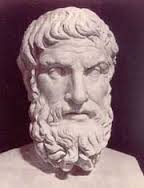
The real person, Epicurus, lived about 2,500 years ago in ancient Greece. He was a philosopher, slightly after Socrates, Plato, and Aristotle, who’s far ranging, and incredibly prescient thoughts and theories ran towards the concept of PLEASURE. Not in a lurid sense, but viewed as an opposite to pain. His perspective was that Humans desired a pleasurable world and life, and generally worked to create that type of environment around themselves. Those who pursued lives of pain and discomfort (especially distributing it to others) certainly existed, but given a choice – most people preferred to be happy during their lives.
It’s odd that our society can only relate the huge philosophical concepts he brought to light, to such a single small category of life – food.
Part of the misconception is because Epicurus apparently had a lot to say, and write, about over-consumption, and food was a big part of that even then. Five Hundred years after his death, Diogenes of Oinoanda (Greek) commissioned a limestone wall, conspicuously located in an open marketplace (the “Esplanade”) to be inscribed with a proclamation to the wisdom of Epicurus – and his verses regarding greed and gluttony. This unique text was rediscovered in the late nineteenth century, but the wall itself had long been demolished! Its blocks had been re-purposed for building houses, paving streets, etc. Amazingly, they were discovered one by one, and slowly reconstructed. It starts like this:
I, Diogenes of Oinoanda, a friend of Athens, hereby inscribe for you, on this wall, my summary of Natural Philosophy.
Most men suffer from false notions about the nature of things, and they fail to listen to their body even though it brings a just accusation. For the body accuses the soul of dragging it to pursue things which are not necessary, even though the Natural desires of the body are small, and easy to obtain. These men do not understand that, while the soul can live well by sharing in the Natural enjoyments of the body, many of the desires of the soul are both extravagant and difficult to obtain. These desires are not only of no benefit to our nature, but actually are dangerous to us.
In my life, I have observed many men in this predicament. I have mourned for their behavior, and wept over their wasted lives. I have therefore composed this inscription, because I consider it a part of wisdom for a good man to give benevolent assistance, to the utmost of his ability, to those men who are capable of receiving it… (see the website below for the whole text)
“The wealth required by nature is limited and is easy to procure; but the wealth required by vain ideals extends to infinity.”
“If you wish to make Pythocles (a friend’s son) rich, do not add to his store of money, but subtract from his desires.
“He who is not satisfied with a little, is satisfied with nothing .”
― Epicurus
Epicurus wrote about food, but more specifically about our relationship to it. He commissioned artwork to point-out overindulgence – of any kind. But also, far more importantly, he also describes the framework of atoms, he studied color and how it seemed to attach itself to objects. He wrote on our relationship to Gods, Life and Death, and how to reconcile them with our lives. He was about perception versus reality. He was not entirely correct, but he was thinking about these concepts, writing about them, and teaching students how to discern reality from superstition – 300 years before the time of Jesus.
For Epicurus, the highest form of pleasure, was friendship – the community of Mankind. Friends, and Science, are reality – Ignorance is an enemy of both.
Defining philosophy as “an activity, attempting by means of discussion and reasoning, to make life happy,” he believed that happiness is gained through the achievement of moral self-sufficiency (autarkeia) and freedom from disturbance (ataraxia).
Almost none of his own writings survived, but about 50-100 years before Jesus time (and about 300 years after Epicurus’s death!), a Roman named Lucretius decided to write a letter to his friend (Menoeceus), who he felt was living an “excessive” lifestyle. In the letter, he uses Epicurus’s philosophy to try to dissuade his overindulgent friend from continuing down the “road to ruin”. Lucretius is relentless in his need to be understood, and he constructs a poem to his friend, which ends up leaving other philosophers and great thinkers in awe for the next two thousand years. The poem is titled – On the Nature of Things.
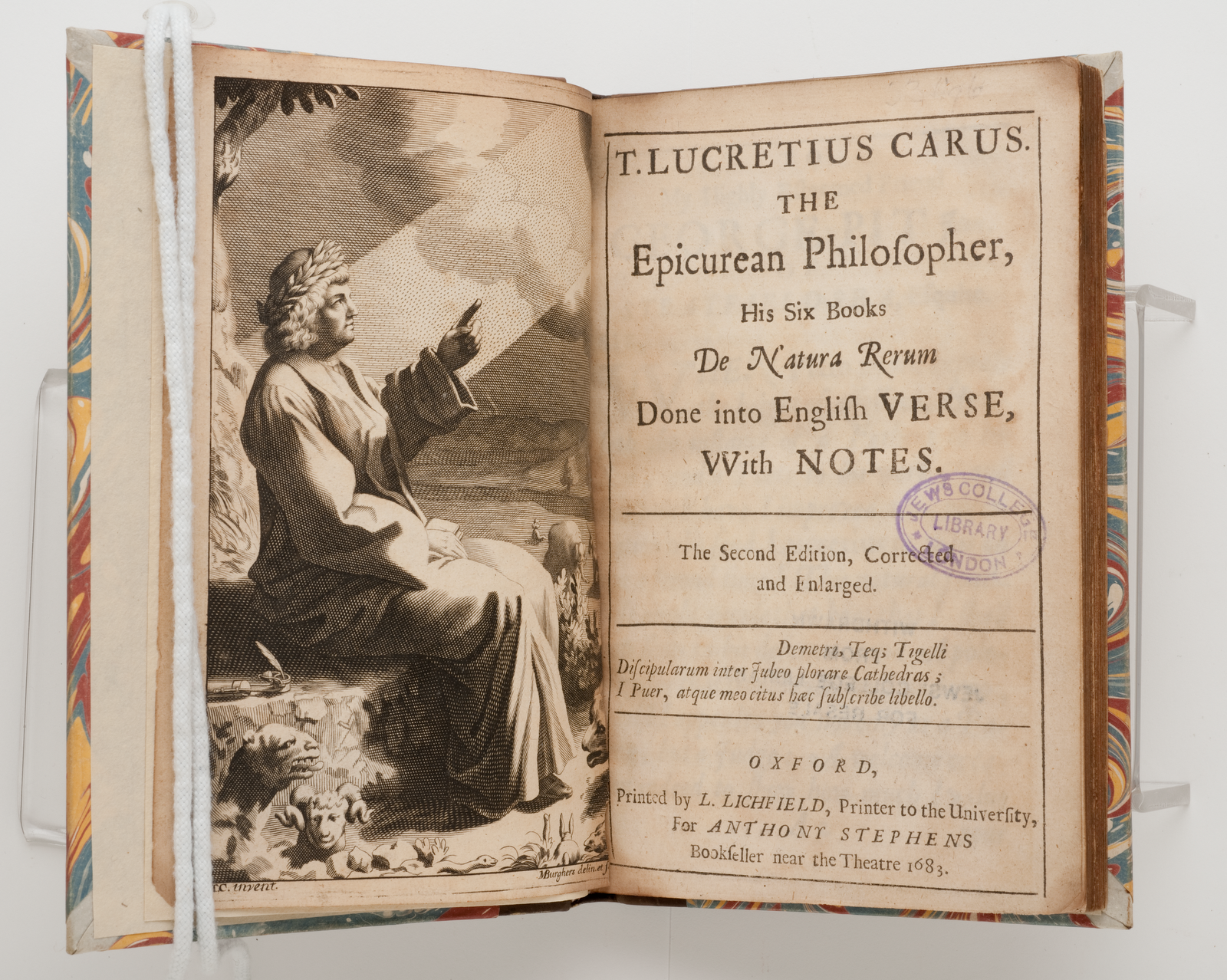
The following passage is from the forward of On the Nature of Things as translated by Martin Ferguson Smith (Hackett 1969/Rev2001 – the only edition I recommend). Lucretius’s original piece was an epic rhyming poem that tried to explain the Greek philosophy of Epicurus to the Romans. And whereas most of the translations into English have tried to keep the beautiful poetic framework, they end up losing the gist, and the beauty of the thoughts. Professor Smith decided to keep the relevance of the dialog versus the rhyme of the poem. This approach is far superior to every other translation I’ve read:
The main obstacles to the goal of tranquility of mind are our unnecessary fears and desires, and the only way to eliminate these is to study natural science. The most serious disturbances of all are fear of death, including fear of punishment after death, and fear of the gods. Scientific inquiry removes fear of death by showing that the mind and spirit are material and mortal, so that they cannot live on after we die: as Epicurus neatly and logically puts it: “Death…is nothing to us: when we exist, death is not present; and when death is present, we do not exist. Consequently it does not concern either the living or the dead, since for the living it is non-existent and the dead no longer exist” (Letter to Menoeceus 125). As for fear of the gods, that disappears when scientific investigation proves that the world was formed by a fortuitous concourse of atoms, that the gods live outside the world and have no inclination or power to intervene in its affairs, and that irregular phenomena such as lightning, thunder, volcanic eruptions, and earthquakes have natural causes and are not manifestations of divine anger. Every Epicurean would have agreed with Katisha in the Mikado when she sings:
But to him who’s scientific
There’s nothing that’s terrific
In the falling of a flight of thunderbolts!
So the study of natural science is the necessary means whereby the ethical end is attained. And that is its only justification: Epicurus is not interested in scientific knowledge for its own sake, as is clear from his statement that “if we were not disturbed by our suspicions concerning celestial phenomena, and by our fear that death concerns us, and also by our failure to understand the limits of pains and desires, we should have no need of natural science”. Lucretius’ attitude is precisely the same as his master’s: all the scientific information in his poem is presented with the aim of removing the disturbances, especially fear of death and fear of the gods that prevent the attainment of tranquility of mind. It is very important for the reader of On the Nature of Things to bear this in mind all the time, particularly since the content of the work is predominantly scientific and no systematic exposition of Epicurean ethics is provided.
Epicurus despised philosophers who do not make it their business to improve people’s moral condition: “Vain is the word of a philosopher by whom no human suffering is cured. For just as medicine is of no use if it fails to banish the diseases of the body, so philosophy is of no use if it fails to banish the suffering of the mind”. It is evident that he would have condemned the majority of modern philosophers and scientists…
Thomas Jefferson was a fan of On the Nature of Things (he had a few copies), and he added Pleasure right at the top of our Constitution – The “pursuit of happiness” was given to us as a Right.
So, how does this ancient poem, and its concept, fit into the framework of my Blog?
First, Epicurus was one of the first to try to develop a Rational Perspective of life, and secondly, as I noted in an earlier Blurb titled 62014, I feel the “technology” of our “timekeeping”, as in our calendar, is a hindrance to understanding our past. The year we currently label ZERO, obscures the past for almost every citizen who is not a “scientist” in his thinking. The year ZERO implies that EVERYTHING regarding Humans started after that point in time. People weren’t thinking great thoughts prior. It implies that Jesus’s great thought – Forgiveness – was the first one.
Oddly, the other philosophers that are still taught about in school – Socrates, etc., are the ones who no longer have much relevancy to our daily lives. I am very happy they are taught, but the subjects which they argue, are the ones that still have no answers, because they are about “mental” concepts, not real physical ones. The exception, Astronomy, they were totally wrong about. Their surviving views are about how Humans think, and give the impression that not much was going on before Jesus.
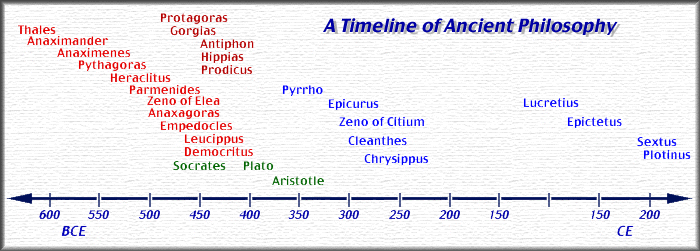
Epicurus was writing about atomic theory 300 years before ZERO. He was teaching it (and he was not totally wrong). He was certainly not the first person to contemplate the physical world around him – the point being that the Intellect of mankind far precedes the year ZERO. Sadly, the philosophy of Epicurus, and his view of the Gods, and particularly Life and Death, was not held in high esteem by the Catholic Church as it was forming in the early centuries. Most of the early writings that didn’t agree with the Church were “purged” – in an attempt to guarantee that the year ZERO really was just that. Aristotle, Plato, and Socrates could be “bent” just enough to fit into the “New View” – In fact Aristotle placed Earth at the center of the universe – the Church had to keep him.
My hope is to add a few years to our calendar so that it too has relevance. So that it includes early Humans. So that it includes the inventions of Man like ceramics, wheels, textiles, metalwork, and all the things Mankind should be proud of. I realize the dates would be vague, but right now, they are almost non-existent – they are BC – Beyond Comprehension.
My original thought was to go back to the original migration out of Africa. That’s a great starting point because it marks the last time that our gene pool (DNA) was all in one place. It was the beginning of diversity. After Mankind left Africa, new foods, and latitudes would change his complexion, by region of settlement, forever.
Time is a continuum, it only goes forward. When history tries to denote some years as negative, or pre-something, the mind does not process them the same way. They are not part of the continuum, they just become bits and pieces of fact that are a vague part of our very general past.
A few recent discussions about “62014”, the Blurb, have led me to two changes:
- The date, and time frame, that I am trying to celebrate is the “population explosion” of mankind out of the “African Cradle” of our ancestors. The “explosion” was probably very tentative and slow at first, but once Humans were hunting in Europe and Asia, there was no containing their (our) growth. The general date for that event seems more agreeable (memorable) at 52015 rather than 62015. That seems valid.
- A little more stress might be put on the fact that – We are already those people’s future; and, We are already those people’s future. How might they view our progress?
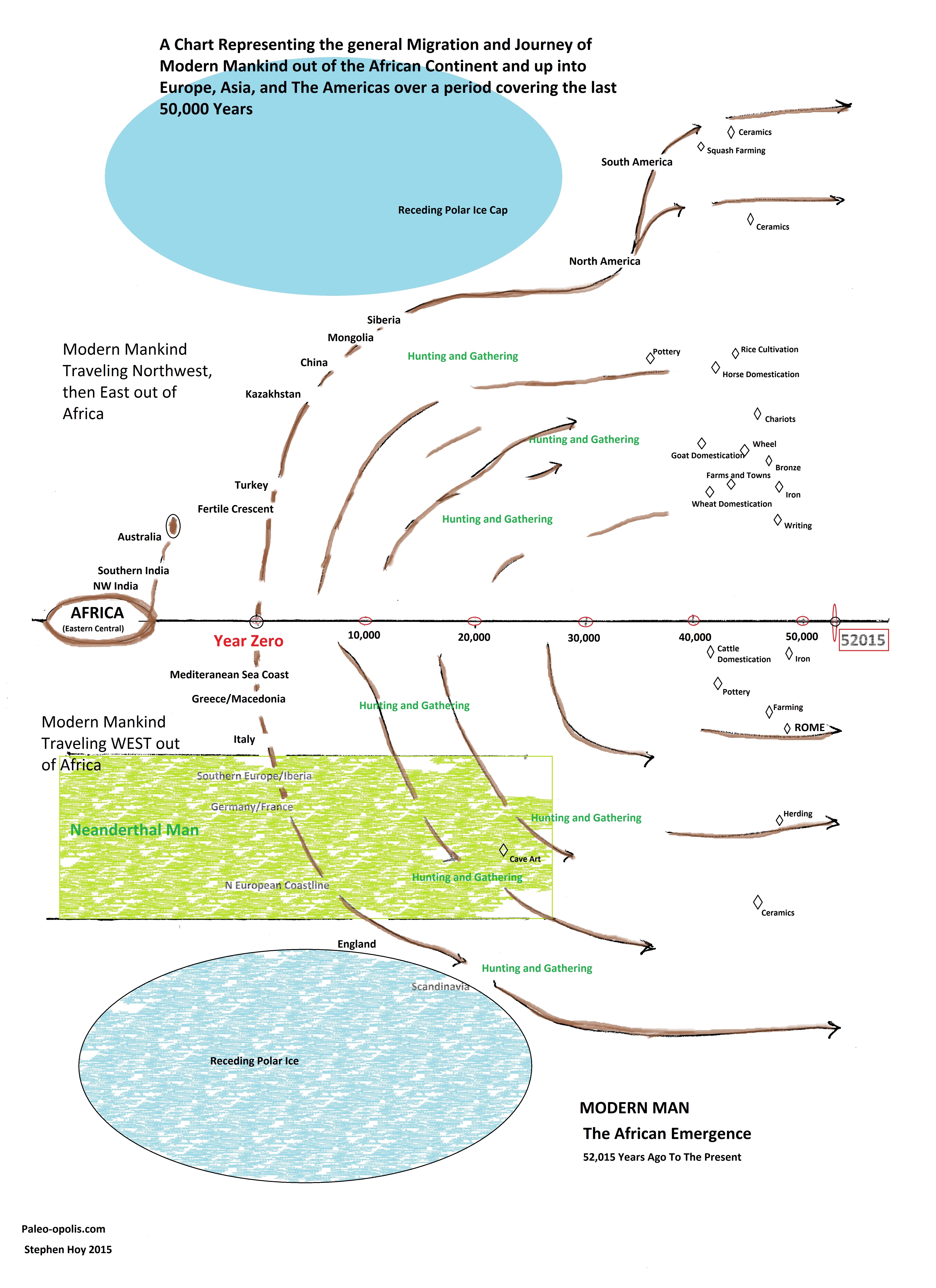
The above chart is a simple representation of the 52015 years since our emergence from Africa.
A Note: For further reading about the history of On the Nature of Things, and the impact it has had on modern society, I highly recommend The Swerve by Stephen Greenblatt (Norton 2011).
 Paleo-opolis