
We have a couple of eggs every morning (usually scrabbled), and I have never really thought to question their nutritional value. Like milk, bread, or meat – eggs have always been considered a basic food staple. But since I started questioning wheat, and found what I found – and then milk, and found what I found (check my blogs on the subjects), almost every food that I held near-and-dear before, now seems suspect. I already knew there was some past controversy regarding their cholesterol content (addressed below), but really, what are the facts?

Well first, I’m not sure if a hunter/gatherer like Steppen would have stopped the pursuit of “real” game, to climb a tree to retrieve eggs. To me, it would seem that eggs were probably secondary on the list of preferable food items. Then again, maybe they were a rare delicacy that were worth losing a larger prey over. After all, birds don’t lay eggs all year, and they are generally hidden up in the trees pretty well… But as it is, almost every type of animal (even some other birds), will eat eggs if they can be easily gained – Humans too. So they can only be as “basic” as any occasional food item might be.
And something else to ponder: In almost every case, in nature, the eggs are fertilized – there are the nutrients of a small, but undeveloped animal still encased. We however, as opposed to Steppen and all the animals, eat unfertilized eggs. Is there a difference?
Let’s start with the eggs that we do eat, the unfertilized ones:

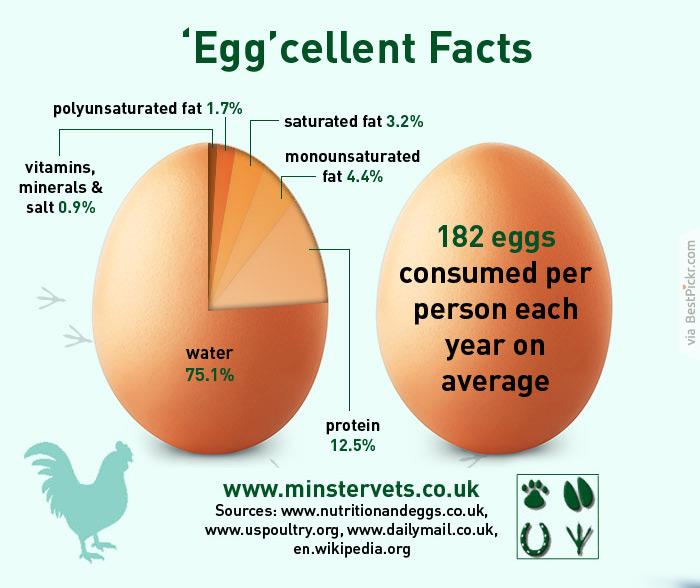
The protein percentage of an egg is about the same as that of wheat! It’s only about 12% of its weight (or about 6 grams for one large, 50 gram egg) – which is lower than I thought it would be, but still about the same as 1 ounce of red meat. Eggs contain almost 0 sugars (which translates to zero glutens or carbohydrates for those of you who ask those questions), but they do have a little saturated fat, some cholesterol (see below), sodium, and potassium, iron and magnesium – all good things for your body. Oh, and they also carry some vitamins – like A, B-6, and D.

And before I go on, a bit of information about that cholesterol issue – since it’s still an occasional topic of conversation. Here’s this from the WebMD:
Cholesterol is a type of lipid, just as fats are. However, unlike fat, cholesterol can’t be exercised off, sweated out, or burned for energy. But, just as homemade oil-and-vinegar dressing separates into a watery pool with a fat-slick topping, so also would fats and cholesterol if they were dumped directly into the blood. To solve this dilemma, the body transports fat and cholesterol by coating them with a water-soluble “bubble” of protein. This protein-fat bubble is called a lipoprotein.
- Low-density lipoproteins (LDLs) carry cholesterol to the tissues. This is “bad” cholesterol, since high LDL levels are linked to increased risk for heart disease.
- High-density lipoproteins (HDLs) carry excess cholesterol back to the liver, which processes and excretes the cholesterol. HDLs are “good” cholesterol: The more HDL you have, the lower your risk for developing heart disease.
- HDLs and LDLs are found only in your blood, not in food.
One large egg has about 186 mg of cholesterol — all of which is found in the yolk. And the truth is that cholesterol (the good kind) is a very important part of the body. Without cholesterol, we wouldn’t exist – it’s a structural molecule that is an essential part of every single cell membrane. It is used internally to make steroid hormones like testosterone, estrogen and cortisol. In fact, it is so important that our liver produces it – even if it isn’t provided in our food.
So, given that we “create” cholesterol when it is unavailable from outside sources, our liver has also evolved to make less, or even none, of it when it is available from a food source instead. The result being that the overall total amount of cholesterol in the body is internally regulated, and actually changes very little (unless it is totally overloaded) – what changes, if you eat badly, is the ratio of LDLs to HDLs. And in the case of eggs, their particular cholesterol seems to attract HDLs – the good ones.
WebMD also says that they have disease fighting nutrients like lutein and zeaxanthin which may reduce the risk of age-related macular degeneration, the leading cause of blindness in older adults. And brain development and memory may be enhanced by the choline content of eggs. But, they also go on to say:
Not all eggs are created equally. Manufacturers and chicken farmers have taken steps to enhance eggs’ nutritional properties, spawning an entire industry devoted to improving the dietary quality of the egg. “Designer” eggs may come from chickens that are allowed to roam freely (free range) or whose feed is supplemented with omega-3 fatty acids. Hens given feed that is free of animal products produce vegetarian eggs, while those given all-organic feed produce organic eggs. Some chicken feed is enriched with canola oil, bran, kelp, flaxseed, marine algae, fish oil, or vitamin E to increase the eggs’ healthy omega-3 fatty acid content. Certain types of feed are designed to reduce the saturated and total fat content of the egg yolk. Marigold extract has been used to increase the lutein content of eggs.
Beyond nutrition, other specialty eggs use a pasteurization process that heats the egg just enough to kill bacteria without affecting the texture of the raw product.
There you go.
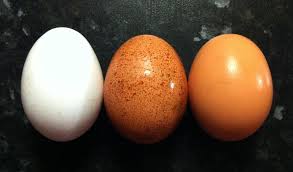
I feel it’s necessary to state here that “designer” does not mean GMO. Chickens have been selectively bred for thousands of years now to produce a variety of breeds, and consequently – a variety of egg sizes and color. The nutritional content of the egg varies only slightly. No foreign DNA has been spliced into commercial breeds, yet. At least not on the supermarket shelves.
So, after all that information, would a fertilized egg bring anything more, or different to the breakfast table? Nutrient-wise?
Study after study says there is NO discernable difference. No cholesterol difference, no nutritional difference, and nothing that would alert anyone eating an egg, fertilized or not, to its status – unless the fetus had started to develop.
The normal way for farmers to tell is by “candling”, which is when they hold the egg over a candle to see the embryo, or if the egg is more opaque than normal. If you crack the egg open, you can also see a difference – the white circle present in the egg yolk is more defined in fertilized chicken eggs than in their unfertilized counterparts.
Lastly, other than the obvious inclusion of housing and feed technology in the poultry/egg production industry, here is the place where I think that my personal “technology versus diet” issue lives:
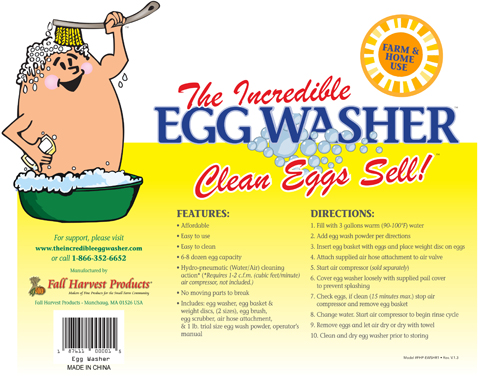
When an egg is laid, it has a natural coating that helps to protect it from bacteria and other microbial intrusions by nature. After all, some eggs sit out in the elements for months protected only by its shell, and a caring, but mite infested parental bird. In the United States, we wash off this protective “skin” after the eggs are commercially gathered. And from that point on, the eggs MUST be refrigerated to be kept safe from bacteria. While in Europe, they leave the “skin” on, and thusly never have to refrigerate their eggs – the eggs remain safe, and the consumer can wash the eggs off when they are ready to be eaten.
The U.S. adds two processes (washing and refrigeration), and 2 levels of expense in the name of safety, right after it removes the safest barrier that nature has evolved –all in the interest of making them look better – what a concept! Marketing rules.
Here is an article on the practice if you wish to read more:
And this:
http://www.npr.org/blogs/thetwo-way/2009/07/new_egg_food_safety_rule_took.html
I will continue eating, and enjoying, my eggs – unfertilized (unwashed if I could find them), and scrambled, thank you. They remain one of nature’s most palatable, and nutritional little packages. However, since I’m aware that our ancestors (until only a few thousand years ago) could not have had a few eggs a day, every day, all year, – evolution might favor moderation (maybe even with a break on occasion) – and your cholesterol can always be checked with an easy blood test if you have concerns.
 Paleo-opolis