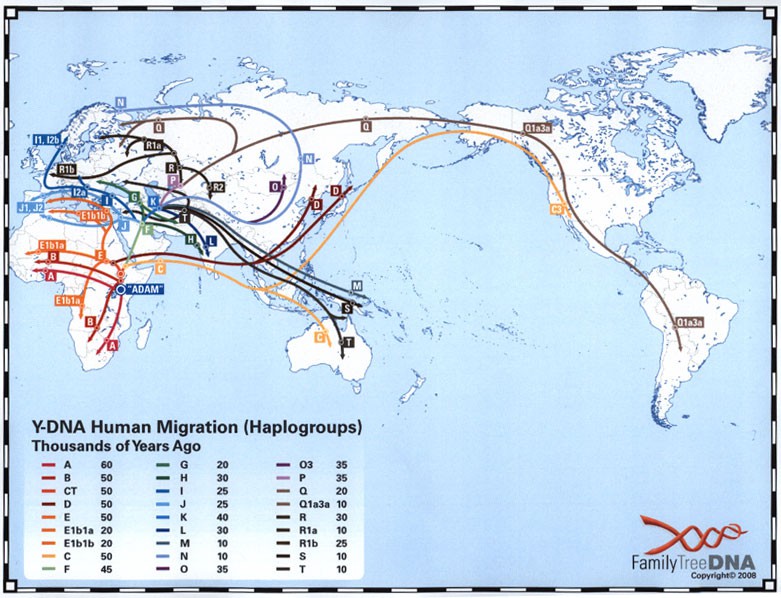
I started this particular blurb because I thought it might be interesting to show how technology, in the form of industrially related Global Warming, might effect both our physiology, and diet – a double whammy. Our physiology because of the health related problems from breathing pollutants, and the general effect a warmer climate has on the reduction of outdoor activities. And then our diet because of the effects of a warmer climate on our water sources, first for our own needs, and then to irrigate crops for our food supply.
The climate for Steppen, 10,000 years ago, was warming also – glaciers were receding from his “roaming” area in northern Europe. He probably endured the occasional horrid winter or extremely hot summer, but the overall temperature swings between summers and winters were not that different from our own – the ancient populations of northern Europe obviously survived them. If the Earth was warming then, and the same pattern is continuing now – what does technology really have to do with it?
It became a little bigger topic than I planned, and certainly not as easy as I’d hoped. There are so many views of Global Warming (“GW” from now on)… from – “It doesn’t exist at all” to “It is the root of all evil (i.e. current medical ailments)” – that my first need was a clarification of facts. My first objective became a simple explanation for the cycles of nature that would cause a “natural” warming of the Earth, vs. a man-made warmth. And, it became clear fairly early-on that, man-made or not, the data (both ice-core and historical readings) pointed to a constant, and alarming rise in our average temperatures over the last few decades.
Here is a short and sweet description of how the Earth naturally creates a warming trend. It is called a Glacial Cycle, and they have been occurring for millions of years – They differ from actual full-blown, Ice-Ages, and it’s in 3 quick parts, so here’s part 1:
There are major differences between the Northern, and the Southern Hemispheres of Earth. The Earth is over 70% water – And of the “little bit” of land that there is, the Northern hemisphere holds 2/3’s of it.
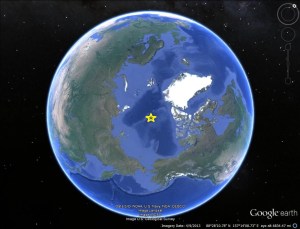
The northern half of our world is where “most” of us live – with the exception of the populations in Australia, a large part of South America, and the lower half of Africa (more on them later). Since “most” of the population, and land mass sits up here, we tend to pay attention to its climate in ever increasing detail. Our large surface areas heat up every summer, and because they are rock and soil, they retain heat much better than water (oceans) that surround us. Also, there is no land at the North Pole, it sits in the middle of a large body of water that has no consistent currents running through it. It is a fairly docile body of water that freezes over every winter, and lately, thaws out over the summer. And, unless it stays frozen, the North Pole does not have the ability to reflect as much solar heat as “normal” (from the snow and ice), and therefore, it is harder for it to retain its “coldness”. The average summer temperature at the North Pole has been going up for quite a while now, and it currently hovers around 32 degrees F.
That was part 1, now part 2.
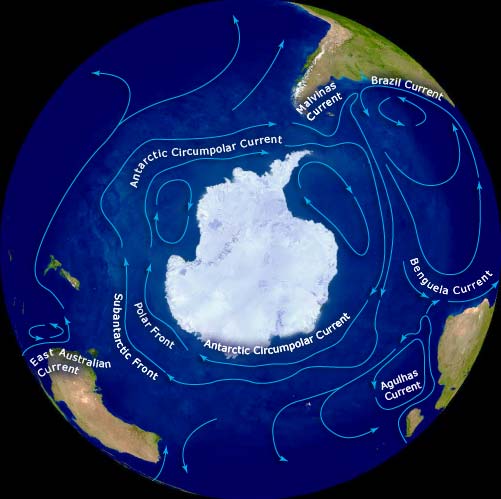
The Southern Hemisphere, on the other hand, is an ice-box. If you don’t count Antarctica, the other land masses really don’t add up to much surface area at all – the less land-mass, the less retained heat. I don’t count Antarctica because it is special.
Imagine a huge, cold block of ice (5.4 million square miles!), sitting on a surface of cold, hard, rock, surrounded by a current of ice cold water that moves around it at a constant speed of about 4 mph, all year round. Like an Ice castle, with a moat of slush – the current is always moving the same direction, always deep, forceful, and ice cold. It is a virtual wall of cold water (and frigid air) that keeps whatever warmth the summer sun might have provided to the Southern Pole, from ever doing much good. The average summer temperature of the South Pole is – 18 degrees F (that’s minus), note the difference between that and the average summer temps at the North Pole. Nearly 85% of the world’s ice is currently “trapped” at the South Pole. The climate pattern there is very slow to change.
And now part 3.
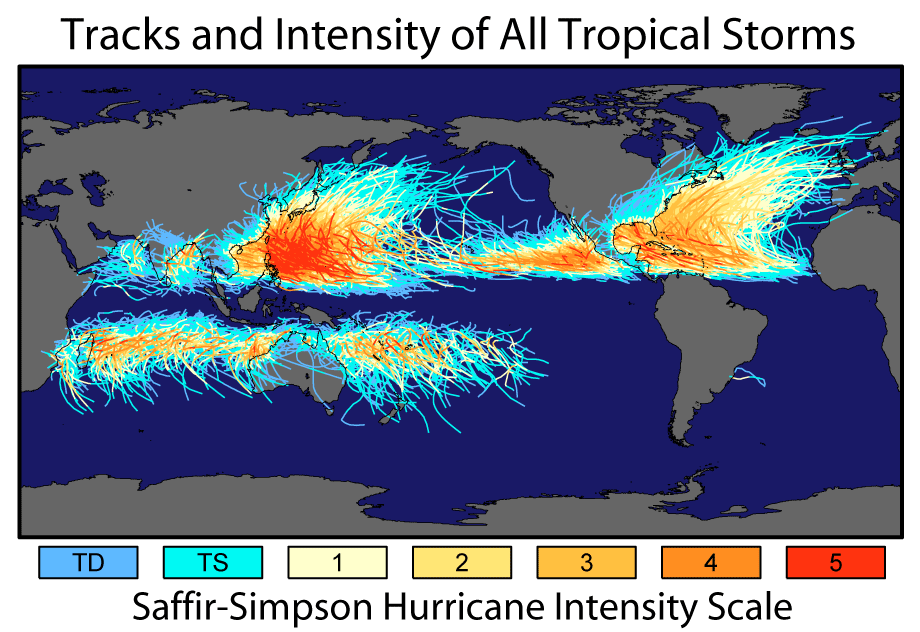
The last heat exchange occurs right at the equator itself, where the solar heated waters become energy-filled storms that will either head north into the larger populations of the world, or south, towards cooler water. This area is called the “Intertropical Convergence Zone” (ITCZ), and this is where large wet storms are produced. Warm water, in the form of a tropical storm (hurricanes, and the like), has the tendency to head towards even warmer water. It just so happens (from the facts above) that the warmer waters, and warmer land surfaces, are almost always north of the equator.
As the storms head north, they gain more energy from the heat, and they generally continue further northward until they have no further sources of energy – with less warm water, tropical storms just fade away. But the key point here, is that almost all of them head north, and each time they do, they take a little more warm air NORTHWARD – away from the southern hemisphere. The northern part of our planet accumulates warmth at the actual “expense” of the south. Also, as water is heated along the equator, it follows currents that have long been dictated by the shorelines of the land masses – like the Gulf Stream Current and its heating effect along the East coast of N America, or the Kuroshio Current near Japan – these also tend to “flow” northward. There are many constant, slow, and steady “leaks” of heat headed toward the northern latitudes, from the south. There are very few corresponding “heat leaks” from north to south.
The end result being that the Northern latitudes have warmer average temperatures than the Southern ones. It was the case during the time of Steppen, and it will continue to be the case for a very long time to come. And in fact, over a very large period of time – the Northern half of our world will continue in its gain of higher temperature averages because, as detailed above, there is a warm air pump, constantly sending most of the warm air variance northward.
If you look at 45 degrees latitude N, you will find the vineyards of France and the huge, fertile wheat fields of mid-west America. If you look towards 45 degrees S, you are already fully south of Africa and Australia – and you will find only the glaciers of New Zealand, or the cold hard lands of lower South America.
This particular global warming cycle began just about the time that Steppen’s ancestors were beginning to push into Northern Europe and Siberia – about 15,000-20,000 years ago. The glaciers that covered the northern latitudes of both Asia and N America earlier, had receded to almost 60 Degrees N by that time, and now in our lifetimes, twenty thousand years later, they are almost gone.
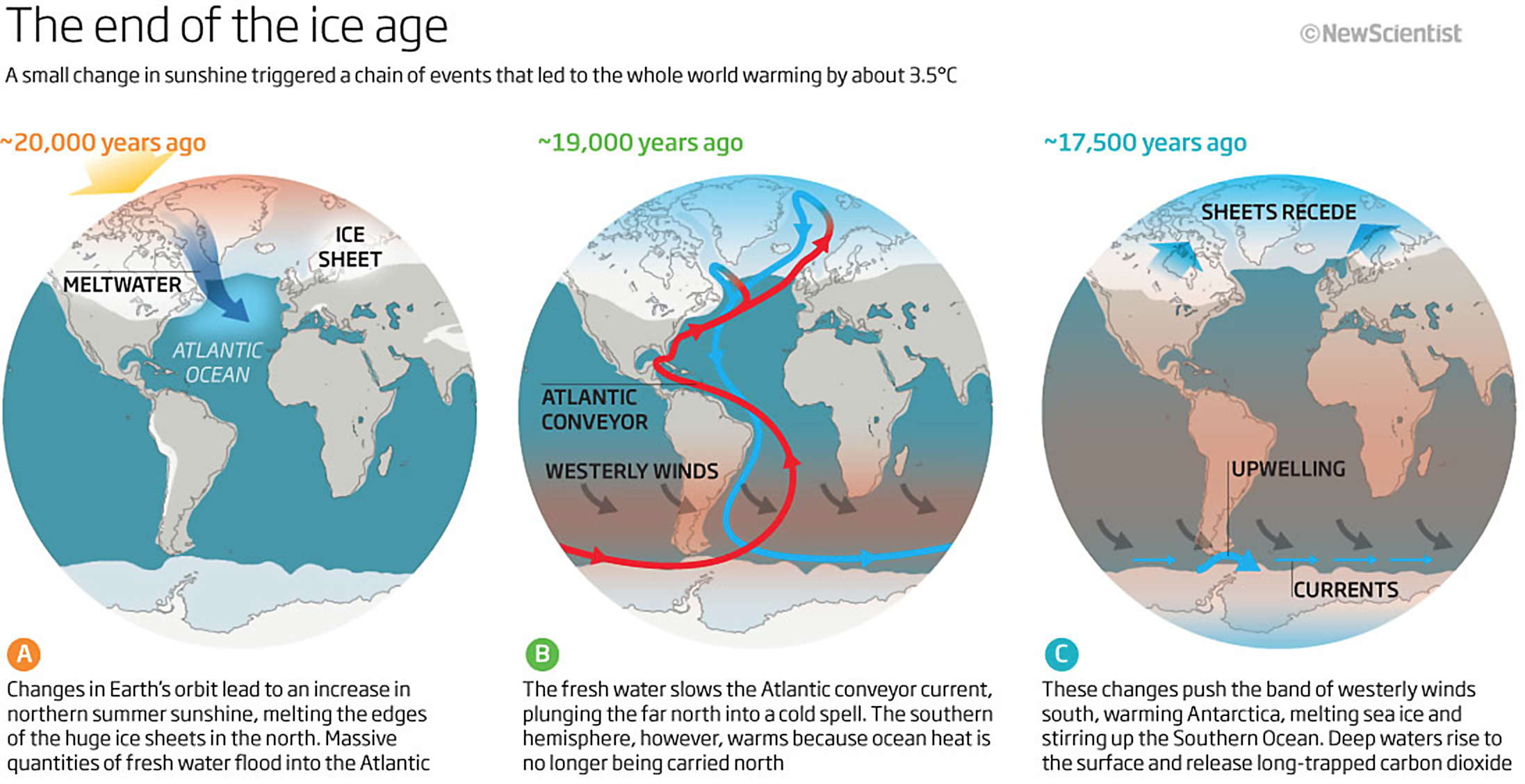
The bottom-line ends up being that there is no such thing as a “natural” planetary balance of heat. History has shown us that our planet is one of temperature extremes – it is always either headed toward a glacial period, or away from one. Currently, we happen to be in a warming phase (In my view, this is much better than being in a cooling trend – at least short-term). The short-term weather swings we see locally, are just small, albeit extreme variances, within a much, much bigger climate arc.
These facts about the historical climate cycles of our planet are certainly enough to account for Global Warming as we know it, but there are still even more factors that have a hand in the outcome.
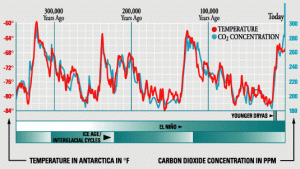
All the historical ice-core data, and other soil-sampling techniques, show that a rise in Carbon Dioxide (CO2) runs hand-in-hand, or even slightly preceding the “normally” rising average soil, and planetary temps. Interestingly, this would be pre-industrial CO2!
The theories mostly run along the lines of – All living things emit CO2 as they breathe. So as life on the planet reaches certain population levels, and exhales enough CO2, it ultimately “triggers” its own death from the CO2 build-up. Since population growth would generally follow the “natural”, cumulative warming of the land surfaces, the graphs coincide. NASA has developed some animations/recreations of the short-term (annual) exchange of hothouse gases based on their own data, and it shows that plant life has a large mitigating effect on CO2, especially in the spring during the blooming process. But the effect is only seasonal, and the next cycle of gases build-up right away.
The “extinction-event”, and glacial cycle, seems to repeat itself every time that our average planetary temperatures reach about 75 degrees F! After that, worldwide temperatures fall-off pretty quickly, Ice begins to form at the northern latitudes, the quantity of life is reduced until CO2 levels fall “enough”, and the cycle begins again. I understand the CO2 build-up, and following deaths, but it is very hard to find good theories that address why the freezing, and the glaciers are “triggered” by the Heat and CO2 levels. CO2 freezes at a much lower temperature than water, and you would think that everything should just keep getting hotter. Well, it doesn’t.
The theories regarding the freezing cycle are far and few between – I’m not sure how I feel about any of them. None gave me an Ah Hah! Moment.
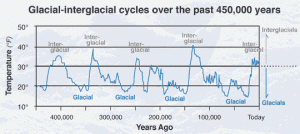
But, it happens anyway. Again and again.
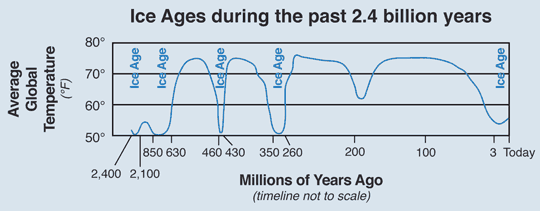
What science does know, is that on a much larger scale, the Earth occasionally gets just far enough from the Sun, while tilting at just the right angle, and at just the right axis – and when these 3 things line-up, it freezes over pretty substantially. Totally rock-hard ice. Luckily, we are nowhere near that situation presently, or even within the next 50,000-100,000 years. However, after the initial thawing of that last covering of ice, and after microscopic life began on this planet, the “CO2 process” must have begun with it. And it is that process, the bloom of the living and breathing of “life” – followed by mass extinctions and a long slow lowering of gas levels, a portion of which is what many scientists feel is being repeated today – The natural warming of the northern lands, and natural populating of the land surface, and the natural rise of CO2 levels as the populace breathes. That seems fairly bleak for us, and even personally, I’m not sure how to put it in perspective, but at least it’s a long way off.
And that leads me back to where I started – What is the impact of technology on all this?
Technology, and current science, since they are now aware of pollutants and their effect on our respiratory systems, are working to reduce and replace many of the natural producers of CO2. However, on a much larger scale, many emerging industrial countries are still geometrically increasing their production of emissions daily. And, while no one wishes to take away anyone’s desire to become a growing, and productive society in the world market – we all, at some level, must be aware that their “growth” directly affects the RATE at which those gases are accumulating. Our industrial technology, worldwide, churns out such huge volumes of CO2 and other noxious gases that it is has become hard for even governments to ignore.
The carbon gases build-up in the atmosphere and act like a green-house to trap the heat that is building-up, and then accumulate it with the heat of the next day. The air heats up, the land surface heats up – and the Earth becomes a car in the parking lot, with the windows rolled up on a hot day. And we become poor little puppies trapped inside. You might be tempted to ask what kind of owner does that to his pets. Then you might be tempted to ask who the owner is? An old Pogo (Walt Kelly) cartoon comes to mind – “we have met the enemy, and he is us”
All living things emit carbon dioxide when they breathe, and I’m sure that 8 billion people exhaling at the same time would have some effect, but it’s the ever increasing volumes that transportation and industrial production add to the picture that take us to new levels.
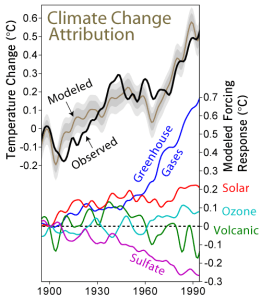
Another pollutant associated with climate change is sulfur dioxide, a component of smog. Sulfur dioxide and closely related chemicals are known primarily as a cause of acid rain. But, they reflect light when released in the atmosphere, which keeps sunlight out and causes Earth to cool. Volcanic eruptions can also spew massive amounts of sulfur dioxide into the atmosphere, sometimes causing cooling that lasts for years. In fact, volcanoes used to be the main source of atmospheric sulfur dioxide; today people are. Another light reflection problem is one produced by jet contrails, which near air centers, can accumulate to cover extremely large areas with man-made “clouds”. Currently, whereas the jet contrail issue has not abated, most of the other man-made sulfur producing activities have been reduced.
So, unlike sulfur dioxide, huge quantities of CO2 are still being pumped into our air – more in some countries than others. And whereas it’s possible that some of it might leak on out into space – our atmosphere and gravity act on even the smallest things, and keep most of it here. The air currents help move our own away from us, but we just end up getting somebody else’s. And while the springtime growth of plant life helps against a surprisingly large part of it (only the CO2, not the other gases) – there is still an incremental accumulation, diluted, but mostly intact.
Conclusion:
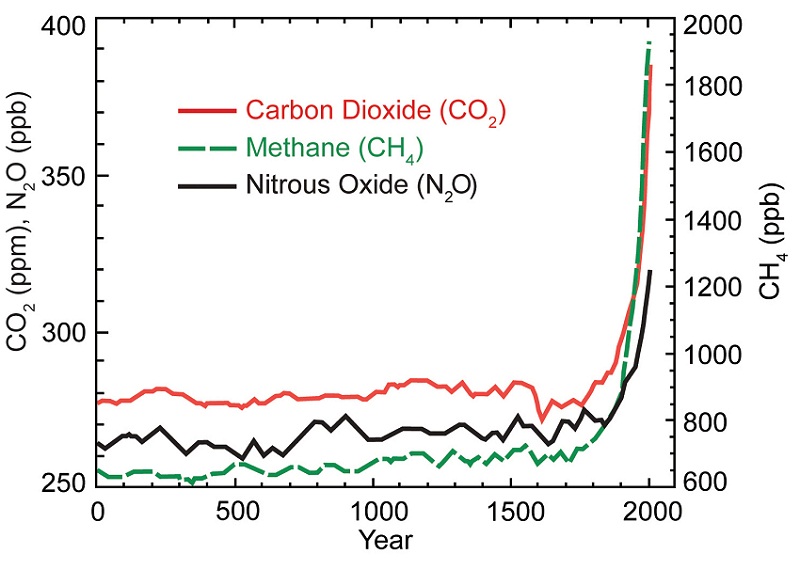
In the end, the data, both government and private, backs up the claim that Human technology has the ability to create noxious gases that have an effect on our health. These gases are also shown to exacerbate the climate pattern and lower the quality of all that accumulating warm air – the very same air that we, and our future generations will be breathing. Even the EPA chart above shows dire levels of CO2 build-up if we continue along this path, mainly because of the progressive effects.
http://www.epa.gov/climatechange/science/causes.html
It it obvious that Human created pollutants have an effect on air quality, the hard part is quantifying it. The NASA animation above shows that quite a bit of it is seasonally mitigated, but we all know it would be better it there was less to mitigate. And will accumulations trigger an “earlier” ice-age – earlier by 10,000 years? 20,000 years? what’s an acceptable rate of response? Unabated, Global Warming will affect our Physiology because we will all be breathing “bad” air, and it will affect our Diet because there will be less fresh water for both Humans and farms. Maybe it’s time for a little more education for the masses. For those who think that the repercussions of GW and Mankind’s additions to it are still a long way off, there is this article regarding one of the current effects.
http://www.npr.org/2014/11/21/365762034/shrinking-glaciers-could-squeeze-washingtons-water-supply
***
To resolve these problems, I think we need BIG, institutions who have the respect of the scientific community – and who have BIG political connections. These are the universities and institutes like the Scott Institute for Energy Innovation at Carnegie Mellon http://www.cmu.edu/energy/ . And whoever figures them out, will need the teeth to enforce the necessary changes. Telling a person, or a corporation, or even a country that they might be hurting our air is easy, making them stop is another thing entirely.
Something related that might be of interest:
 Paleo-opolis