I’m going to merge two related articles that appeared recently in the syndicated newspaper column of Marilyn vos Savant, called Ask Marilyn. She is noted as one of the most intelligent people in the world, and she has a talent for clear answers to her readers’ questions.
The question was “What happens to the natural fiber content of fruits and vegetables when they are canned?” Her answer covers a lot of ground:
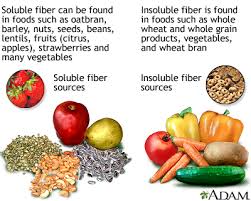
It stays right where it is (apart from any peels, stems, etc., that are removed). Though canned fruits and vegetables may be softer, texture is not what makes fruit fibrous. The impression that their fresh counterparts have much more fiber is incorrect. Fiber (also known as roughage) is simply the part of the plant foods that is not digestible by our gastrointestinal enzymes. This has no relationship to a crunchy bite. Some canned foods – certain common beans, for example – often have more fiber than the varieties you’re likely to find at your neighborhood grocer.
Water-soluble fiber may dissolve into the canning liquid if the food is mechanically separated, as with chopping, etc. But cutting fresh fruits and veggies for cooking also may cause fiber to dissolve in the cooking water.
But, canned or cooked in water, neither of these types of fiber is “digestible” in the sense that they provide nutritional value. They do not. Yet both play major roles in the digestive process. Non-soluble fiber remains more intact as it passes through the intestines; water-soluble fiber forms a gel-like substance.
_
I used Ms. Savant’s answer because she tends to get to the heart of a question, gives an accurate answer, and makes it understandable – oh, and her answer did not raise any protest from nutritional specialists. However, I will try to refine why fiber has begun to play a larger role in “the digestive process”, and even more so, in dietary marketing.
***
The underlying concept for fiber consumption is that it helps the digestive process.
Now, If I go back to an evolutionary look at the issue (once again via Steppen), and I look at the seasonal variation of his food sources (and that of Europe for tens of thousands of years), I’m seeing fiber (from vegetables and nuts) as an occasional dietary entry – and since it is not a year-round possibility (due to winter), nature tends to not make it a necessity (just like sugar!).
If fiber were necessary to aid digestion or the poop process, Mankind would have been constipated about a third of each year – only hibernation allows that kind of process.
Our ancestors ate animals (the only constant food source) all winter, and not many “interior parts” of an animal have fiber – they are all pretty digestible – and nutritious.
***
From my perspective, fiber has only become “necessary” because we poop in an unnatural position. Poop will ALWAYS have trouble traveling “sideways” through our lower intestine because we “sit” to poop. Poop, and its path through our intestines, evolved to travel “Down” and out – not across and out.
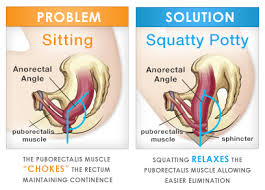
Because of the poor design of our toilets, it seems our digestive system needs the equivalent of a “rotor-rooter” every once in a while – just like the pipes on your house. But, if you poop from the proper position, evacuation is complete – there is far less opportunity for anything to “stick” to the intestinal lining (if all the pipes in your house could head straight down, rather than across, there would be far less corrosion – fewer places where things can “sit too long”).
From what Ms. Savant says, the fiber you consume might as well be cardboard, I imagine that in many cases, that is far closer to the truth of what you’re eating than you think. When I see a label that says “fiber added”, the only thing I know for sure is that it is indigestible.
As to fiber’s purported ability to help in the fight against cholesterol; first the scientific and medical evidence is slim at best, and then there is the basic question: “if something is by definition, not digested – and passed right on through your intestines, how does it make its way into your blood and arteries?”
I applaud the agricultural industry (and their marketing agencies) for finding a home for what was “waste product” 30 years ago. Obviously the breakfast cereal and energy bar manufacturers have jumped on board, but I’ll pass – just like my poop.
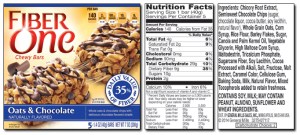
I’ll continue to eat my fruits and vegetables – for their vitamin and mineral content, rather than for their fiber and carbohydrates – they taste the same either way.
Please see my blurbs on The Proper Way to Poop.
 Paleo-opolis