Not to be too dramatic, but… sugar is the root of all obesity.

And the reasons, given evolution and chemistry, are very simple and clear.
The evolutionary part involves every single one of your ancestors EXCEPT the last few pairs. The exceptions to the ‘evolutionary chain’ are you, your grandparents, and then MAYBE back to their grandparents. Up until that point, when it was winter in North America, Europe, and Asia, there were no vegetables. When it was winter, there were no crops. When it was winter, there was only meat, nuts, and stored grains.
Grains have their own evolutionary history, but they still only go back a few thousand years. Maybe eight to ten thousand years for some areas around the Mediterranean Sea, but for most of mid and Northern Eurasia it was well under five thousand – and they don’t get to North America until after Columbus. I don’t think grains have had enough time to affect our DNA, as a whole population, but certainly some societies have adapted to its use as a nutrition source better than others. It might be comparable to lactose tolerance (which is a DNA mutation), and the use of milk (to avoid starvation) by some early societies (and at about the same time frame).
Sugar did appear naturally in the form of Honey, but I feel fairly safe in thinking that honey was an occasional treat – with long odds against finding it in the winter.
The point being that for most of our Human existence, our consumption of sugar has been minimal, and cyclic, at best. And when sugar did appear, in its natural form of vegetables and fruit, it would have been “wrapped-up” in the plants fiber, where it digests slower (more like a timed-release) than our current processed sugars.
With this perspective, it is easy to see how Grocery stores, and the huge industry of food transportation, have changed our relationship to foods, and sugar in particular. Whereas we can now get all the healthy vegetables and fruits we could ever ask for, no matter the season, we can now also get all the sugar we could ever want, and more! In a thousand forms, with a million eye-catching wrappers.
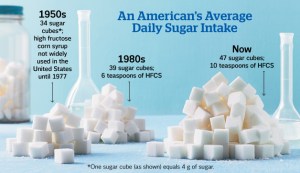
Sadly, we have a pancreas that evolved to deal with sugar in limited doses, at particular seasons of the year. With the sugar amounts that we now have the potential to ingest, we would need a pancreas the size of your head. An little organ that once worked part-time as an insulin producer, is now forced into 24 hour servitude – alternating between storing the sugar as fat around your waste (and organs), and sending you to the bathroom to pee. Depending on how late you eat, it may never get a chance to rest. To understand why requires just a little bit of chemistry.
So now, just a little bit regarding the chemistry of Sugar:
Sugar is the combination of Carbon and Water (hence its other name: carbohydrate > hydrated carbon). If carbon and water could be combined just willy-nilly, it could rain sugar from the sky, or there would be sugar mines everywhere – because those elements (carbon, hydrogen, and oxygen) are extremely plentiful on this earth. Well, it doesn’t rain sugar, and there are no sugar mines.
Sugar, in nature, is a biological combination – not one forged in heat, or pressure. Almost every living thing on earth “creates” some form of sugar to run through its “veins” in order to provide energy to its cells. Plants create sugar, fish create sugar… Humans create sugar. In us, it is called Glucose, and it is created in our liver. We have always internally produced as much as we need – as long as we have had water, proteins, and fatty acids – Spring, summer, fall, and winter, vegetables or not, fruit or not, honey or not…
There are no essential sugars. There are no ‘outside’ sugars that are required by your body. The same for your dog, your cat, your fish… Over a decade ago, The United States and Canada began a joint program to study and then build a data-base called the Dietary Intake Reference Guide. I have included pages 265-338 below, which is the section on Sugars and Carbohydrates. This is from page page 275:
Clinical Effects of Inadequate Intake
The lower limit of dietary carbohydrate compatible with life apparently
is zero, provided that adequate amounts of protein and fat are consumed.
However, the amount of dietary carbohydrate that provides for
optimal health in humans is unknown. There are traditional populations
that ingested a high fat, high protein diet containing only a minimal
amount of carbohydrate for extended periods of time (Masai), and in
some cases for a lifetime after infancy (Alaska and Greenland Natives,
Inuits, and Pampas indigenous people) (Du Bois, 1928; Heinbecker, 1928).
There was no apparent effect on health or longevity. Caucasians eating an
essentially carbohydrate-free diet, resembling that of Greenland natives,
for a year tolerated the diet quite well (Du Bois, 1928). However, a detailed
modern comparison with populations ingesting the majority of food energy
as carbohydrate has never been done.
It has been shown that rats and chickens grow and mature successfully
on a carbohydrate-free diet (Brito et al., 1992; Renner and Elcombe,
1964), but only if adequate protein and glycerol from triacylglycerols are
provided in the diet as substrates for gluconeogenesis. It has also been
shown that rats grow and thrive on a 70 percent protein, carbohydrate-free
diet (Gannon et al., 1985).
They could not have made the sentence structure I highlighted any more convoluted, but the bottom line is unavoidable. As much as they did not want to concede it, we are self-sufficient in the sugar/carbohydrate arena. Please, read it for yourself at their website (and, read my blog on the Low-Carb Diet):
Any of us who consume “excess” sugar – which is any sugar not wrapped-up in vegetable and fruit – will store it as fat (unless you also have a lot of time for “excess” physical activities).
The stored Fat, which is a by-product of excess sugar, has a definition too.
Fat is the chemical combination of three fatty-acid molecules held together by one sugar molecule (called a triglyceride), the sugar is the binding agent. Fat can’t be made of anything else. Every fat cell is made of these two things, in this combination, every time. There is no other kind of fat stored in your body.
So, since obesity is “excess” fat, here is the key to obesity:
If there is no excess sugar, there is nothing your body is compelled to (or able to) store, and because of that, there is very little possibility for the accumulation of body fat. Your body will either use the fatty-acids or send the excess out the back-door – there is no glue to hold unused fatty-acids together. And if you think sugar is not glue-like, think of honey, paper mache (where starches are glue), and the stickiness of candy. It is just as “sticky” inside your body.
***
I understand mankind’s “manufactured” need for sugar. In some forms, people have come to crave it to the point of obsession. But to label that craving as evolution-driven and necessary, would be to say the same for the craving for drugs, and other forms of mental release (cocaine, alcohol, heroine) – we all know that these are exceptions to daily life, not essentials – maybe even detrimental, but no less craved. The Sugar industry was already powerful enough to be two parts of the Slave Trade Triangle in the formation of the early Americas – The slaves were imported to harvest the sugar crops, then the sugar was exported, much of it in the form of rum. Hawaii is a state because of its sugar producing climate. We, as a country, invaded it to keep the “right” to grow sugar cane there. Sugar drives huge economics in this country. Think of how much crop acreage is devoted to corn, sugar beets, and wheat. As much as we would like it to be different, even wheat is still over 80% sugar – it makes great alcohol. Barley becomes the fermented sugar of beer. Sugar is pervasive.
All alcohol is sugar-based, pasta is mostly sugar, bread is mostly sugar (in the book Wheat Belly, each slice of bread is shown to be the sugar equivalent of a candy bar!)

We like sugar, no, we love sugar. But don’t mistake that desire, for a need. Once sugar is removed from vegetables and becomes processed (or fermented), it ceases to be good for us in any nutritional way (not that it was ever really nutritional). I won’t argue that it tastes great, or that it adds flavor, or even that I too, would like to eat it all of the time for no particular reason. But, just try to remember to put into perspective: It is NEVER necessary, and it is ALWAYS excess.
 Paleo-opolis