
Most of my life, I have held an anti-vitamin stance. I didn’t have any particularly good reason for holding that opinion. I think I had a tendency to place one-a-day type supplements into a general “snake oil” category – and underlying it all, was the feeling that most of those supposed nutrients were just going to be passed right on through the next time I stopped to pee.
Since I have been studying diet from an evolutionary (rational) perspective, I realized how much our current “food culture” has skewed our nutritional intake. Basically, we no longer eat the WHOLE animal. We tend to like the muscle, but we tend to avoid the “innards”. Unfortunately, as good as a thick piece of steak may taste, it carries very few of the minerals and vitamins that are an important part of Human health. Those nutrients were in the animal, we just no longer eat those parts. I am no different – it is the way our culture looks at food, it is certainly not the same in every culture.
Anyway, since we now by-pass most of the nourishment that our ancestors gained from a carnivorous meal, we need to get those nutrients back, especially the essential ones.
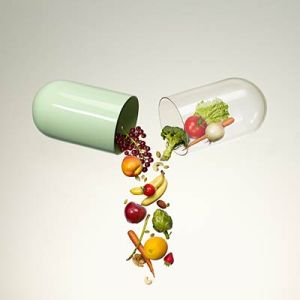
Vegetables are a great source, and some people can organize their intake such that all the vitamin groups are covered, but most of us don’t. Many people think that pastas, and breads, and whatever other “enriched” foods will take care of it. Maybe – but probably not.
For me, it just seems so counter-productive to eat supplement-enhanced sugar (in whatever form it takes).
Once I understood that my diet couldn’t provide all of the necessary ingredients for health, I knew it was time to adjust – with caveats.
The first problem I have, has to do with frequency. I feel we need to get rid of daily-dose mentality, it does not occur in nature. Will the body will stop collecting, or retaining some of them due to the artificial overabundance? Iron comes to mind first – It happens to be the one mineral that red-meat retains in abundance. It’s so prevalent in our soil that even vegetarians probably aren’t lacking it.
And regarding overabundance, calcium is still in almost all tap water nation-wide, you know it’s in yours if you get a mineral build-up in your coffee maker (it’s the white build-up left as the water boils away). If it’s already in your water, why do you need it in a pill? The real question would be “Why isn’t it staying in my body, and in my bones?” or even better “What do I need to change to make it stay?”
For example: In my case, coffee tends to make magnesium want to leave – do I take magnesium supplements? Or do I stop drinking coffee? Do I just try to drink less coffee?
One of the best statements I’ve read regarding supplements so far, is from the book Wheat Belly by William Davis, MD. He says, after discussing the ability of acidic foods to shift our blood pH enough that the body starts to take the calcium in our bones for a ‘buffer’:
“… Taking calcium supplements is no more effective at reversing bone loss than randomly tossing some bags of cement and bricks into your backyard is at building a new patio.”
The next dubious supplements that come to mind, are those related to hormones. I feel that there are many people with real medical needs. I also feel that that many of the people taking excess hormones, are filling “emotional” needs, which are probably not physically related.
For me, the perfect example might be testosterone.
Research has reinforced my thought that successive male children may carry lesser amounts of testosterone by evolutionary “design”. The rationale would be that in a small group or society, if all the males carried the same level of T, then competition for procreation would be full-time and VERY fierce. A society only thrives with varying levels of male aggression – there will always be the need for those males that will acquiesce, and wait their turn; maybe they are seen as “thinkers” versus “doers”, brain versus brawn.
To assume that all males need to be “topped-off” by drug therapy (as TV commercials would have you think), (even the old ones who should be just grumpy, not physically aggressive), is foolish and wrong for everybody. Is testosterone somehow related to self-confidence?

Then, there are Probiotics. Research shows that good colonies of gut bacteria are key to overall digestion, and health. Research also shows that some foods (wheat in particular) contain ingredients that are capable of stripping the bacteria right off the walls of your colon! Gluten is one of these (gluten just happens to be the “protein” part of a grain, so if something has the gluten removed, it no longer has any protein – at that point, why bother to eat it at all?). So, if you eat wheat, and you have stomach problems, my first advice would be to try to give up wheat for a week and see if that helps, if not, probiotics might be an answer.
Our reality, given the foods that we tend to enjoy in this country, is that we DO need nutritional supplements.
Try to be rational in their consumption.
 Paleo-opolis