
Calories,
And the Counting Thereof
Since nutritional labeling has been required on food packaging (1990), calories have been a large part of any discussion about diet. And I think most people have a vague concept of calories in general – some people think of calories as the energy content of food, while others think of them in terms of something needing to be burned off. Both are kind of correct, and both are kind of misleading.
100 calories of carbohydrates (sugar) can be turn into fat, so yes, they need to be thought of as energy… which needs to be burned off.
100 calories of protein, can NOT be turned into fat. They are also energy… but your body will expel them through the normal digestive processes if they can’t be used.
Big Difference.
Currently, for labeling purposes, and regardless of whether they are protein, fat, or sugar, calories are scientifically gauged in two ways – and both are based on the exact same principle. Burning food samples.
The first process, which is used less and less (the reason will become obvious), requires that a measured amount of food sample be “flash” burned in a pure oxygen container. The energy given off by the event, in terms of temperature produced by the burning sample, is measured in calories (actually kilocalories). It is called the Bomb Calorimeter method.
The second process, which has become more commonly used, is based on calculations made in the 1800’s by Wilbur Atwater (1844-1907). He determined the average number of calories in the three main sources of food energy: fat, carbohydrates, and protein. Per his calculations, fats were worth around 9 calories per gram and carbs and proteins were worth 4 calories per gram.
The “4-9-4 Method” or the Atwater System is how most calorie values on food labels are determined today. For instance, a bag of crackers that has 5 grams of fat, 22 grams of carbohydrate, and 2 grams of protein should contain around 140 Calories.
Here is the bizarreness, Atwater determined with these numbers over a hundred years ago, as averages, using older equipment, to come up with an approximation of the first process (the far more accurate bomb calorimeter wasn’t invented yet).
The FDA allows either, so which would you use?
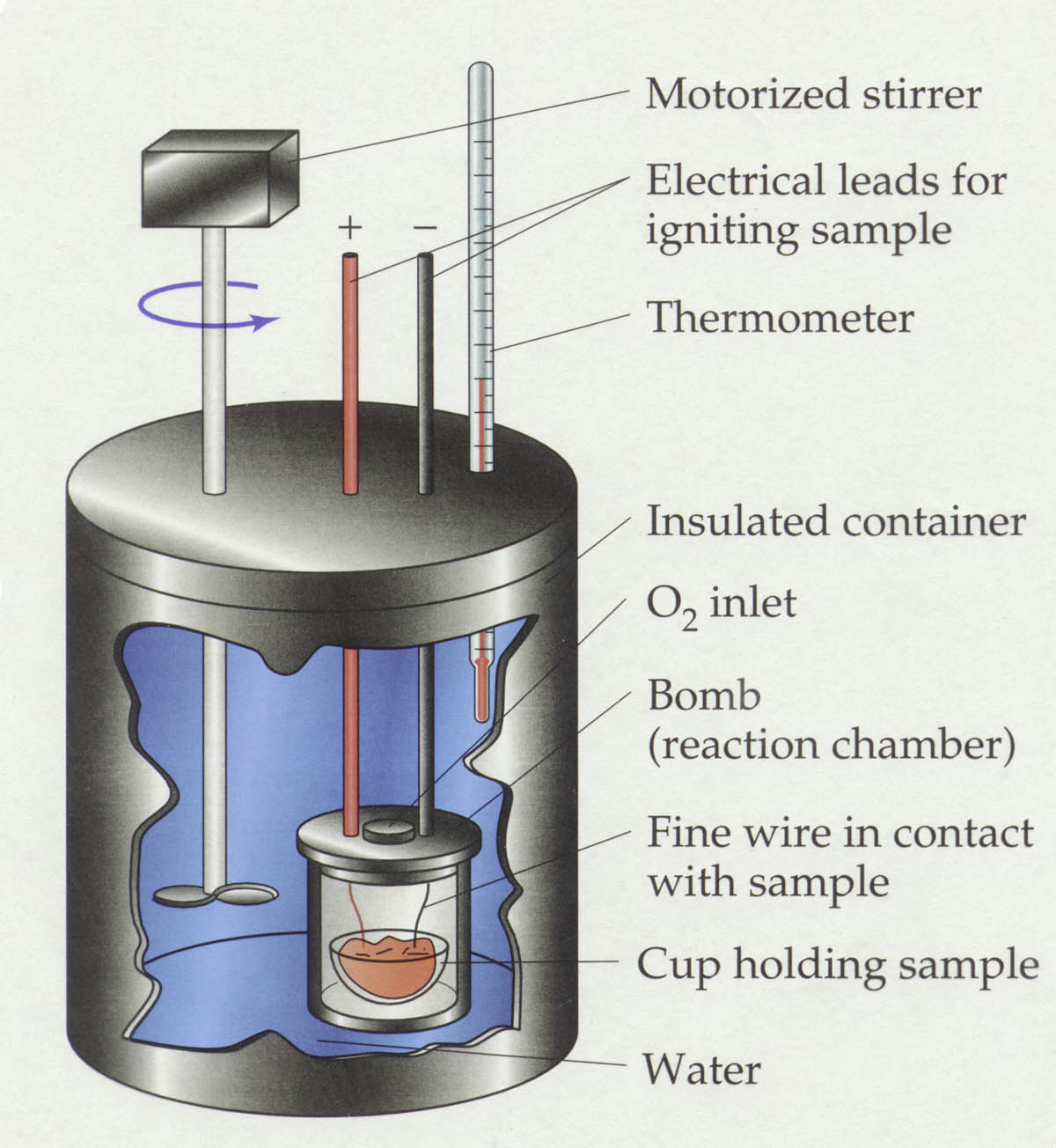
But now to the heart of the matter – Do our bodies really utilize food buy burning it? Do we have to keep the “food fires” stoked to use energy? Are we like a locomotive?
Not really, and actually, not even as a rough approximation. We metabolize food by reducing it with stomach ACID – And that’s not the same at all.
For us, first the acid separates proteins, fats, and sugars – and then different organs and parts of the body go to work with the molecules blood brings to them – be they vitamins, minerals, or nutrients. Our stomachs do NOT “flash fire” the whole meal at once. Some foods may take days to digest. Meats tend to digest very slowly, whereas mushy foods might get through in under a day. In our body, sugars are extracted from the food source slower if they are wrapped up in fiber, like they appear in vegetables. If the same weight of sugar came in a candy bar, or bread, it triggers insulin immediately, and it is dealt, as in “burned” differently – IF it can be “burned” or utilized at all.
You would think that if you can measure the energy provided by burning a gram of food, you can certainly measure the energy provided when it is dissolved in hydrochloric acid. Maybe that should be the proper test.
But even that still leaves most of the same problems because of the myriad of ways that calories can be metabolized. Sometimes foods that seem to be equally low-calorie really aren’t. Here’s an example: A chicken breast and a hamburger are both high-protein foods. Both should have the same number of calories per ounce. But if you serve the chicken without its skin, it contains very little fat, while the hamburger is full of it. A 3-ounce serving of skinless chicken provides 140 calories, while a 3-ounce burger yields 230 to 245 calories, depending on the cut of the meat.
And: In a study published in the Journal of Nutrition in 2008, U.S. Department of Agriculture researcher David Baer concluded that “nuts are a food group for which substantial evidence suggests that the Atwater factors may be poorly predictive.”
Bear found that whole almonds have about 20% less calories than the value calculated using Atwater factors. In a separate study, he found that pistachios had 5% less calories than originally thought.
This has to do with how nuts — especially whole nuts — are absorbed by the body. With whole nuts, compared to peanut butter or peanut oil, more fat ends up in the poop. People who eat more nuts also lose more fat in the stool.
The way people chew their food also makes a difference. The more people chew their food, the more calories are absorbed.
In nuts, a lot of the fat is stored inside the cells walls. So if the cells are not broken during chewing they may pass right through the gastrointestinal tract without releasing the oil they contain.
***
Having to count calories at all, implies that ALL of them can be bad – and they are to be watched carefully or they will harm you.
When, in reality, ALL food has calories. Whether it is the most nutritious in the world, or the absolute worst thing you could possibly eat – you count them because you are afraid of adding too many.
And what seems to go unheralded (and I stated at the beginning), is that protein can’t turn into fat no matter how many calories it has. Sugar, on the other hand, will almost ALL turn to fat, no matter how many calories it has. Fats from nuts – no problem; fats from processed oils – probably a problem, but not a diabetic type of problem, maybe more of a heart-disease type of problem.
***
A “calorie” is a useless fact. It tells you that if the snack you are eating is burned, it gives off energy. Duh. Even corn flakes or a pile of sugar does that. So does wood.
Maybe what we need is just a label that states, by weight, the amounts or percentages of protein, natural fats, other fats, and sugar (and yes, I’ll say it again, all carbohydrates are sugar) that any processed food contains.
Don’t count calories, count sugar.
***
There was a study done by researcher Sara Bleich, an assistant professor of health policy and management at Johns Hopkins’s Bloomberg School of Public Health in 2011 to see if calories could be presented in a manner that was easier to relate to everyday life.
The research suggested that displaying the amount of time you’d need to jog in order to burn off the calories from a sugary drink, rather than showing a calorie count, may be more effective in dissuading you from consuming those beverages.
Researchers observed teenagers at stores in West Baltimore, where signs displayed either calorie counts, calorie counts as a percent of recommended daily calorie intake, or the time spent jogging that would be needed to burn off those calories. While all led teenagers to purchase fewer sugary beverages, the conversion to exercise minutes was the most effective.
Researchers calculated the exercise times based on a 110-pound teenager, and jogging was chosen because many people don’t like to do it, Bleich said. Exercise times, she noted, would vary depending on a person’s weight. For example, a 110-pound person would need to jog for 50 minutes to burn off a 20-ounce bottle of soda, whereas a 150-pound person would need to jog for 40 minutes.
The study appears in the Dec. 15, 2011 edition of the American Journal of Public Health.
If you must count calories, I like this approach, and it has been reintroduced lately. I think it is perfect for all Sugar products, but don’t try to tell me how long I need to work out to keep my salmon fillet from turning into body fat – It can’t happen. Even If it has 1,000 calories: a) it’s just too big to eat, and b) it may be uncomfortable, but the excess will pass through.
 Paleo-opolis