
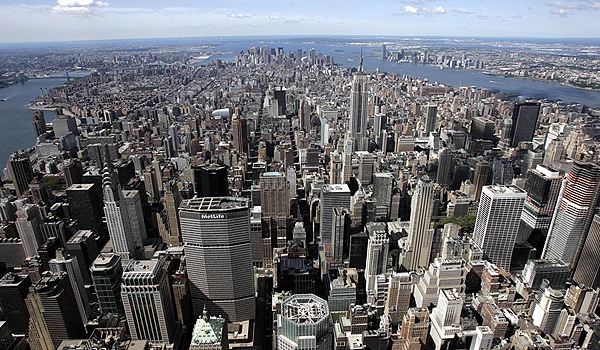
We take concrete for granted. It is prevalent, it is everywhere. If you’re driving cross-country, you will notice that as you get near urban areas, the double-lane concrete highway you were on , all of the sudden, multiplies into a thousand cross-streets, side roads, side-walks, parking lots, stores, buildings, skyscrapers – and some of these sights might even be blocked from view by 12 ft. tall concrete sound-barrier walls. As building materials go, concrete is expedient, and very, very long-lasting.
Even though cement can occur naturally, it looks just like any other rock. Man saw the use for rock-piles because they could block the wind, but he had trouble finding a way to hold the rocks together. Prior to the Romans, there is evidence of concrete-like substances used as mortar to hold rocks together, much like the Egyptians used in constructing the pyramids, and Chinese used to build the Great Wall. But it took until 300 BC, for the Romans to get it down to a science.
The Romans used slake lime and volcanic ash (called pozzuolana) mixed with sand and water, (with occasional admixtures of animal fat, milk, and blood) to create structures that have been standing over 2,000 years! Even many of their original their seawalls are still standing after thousands of years of wave-pounding erosion. Concrete makes an extremely hard surface.
When Rome fell about 400 AD, the art and science of concrete vanished. It was tied to the knowledge of certain trades and people, and when they fled Rome or died, their secrets went with them.
Concrete doesn’t show up again until over a thousand years later in some experiments and writings in the late 1600’s, and then it is another 100 years before a patent is issued in England for hydraulic cement (stucco) to be used in exterior plastering, and minor construction. Here, I must insert, is one exception – and even though it doesn’t really count as concrete, it was an interesting alternative – in 1672 the Spanish fort in St. Augustine FL was built from millions of tiny crushed-up Coquina shells (with the mollusk). It is massive, and it still stands today.
Finally in 1824, a bricklayer in England gains the patent for Portland Cement, but it is too new to be used the in the first major concrete project in the U.S., the Erie Canal (1825). The first shipment of Portland Cement doesn’t get to the U.S. until after the Civil War is over (1868).
In 1889 the first concrete reinforced bridge is built. 1891 brings the first concrete street in the USA in Bellefontaine, OH – It is still there. 1904 brings the first skyscraper, and 1936 brought the first Dam construction projects (Hoover, and Grand Coulee). By the Mid 1950’s the Federal-Aid Highway Act brought about the incredible Interstate Highway system we are still driving on now.
***
Here’s the problem, other than it making a lousy walking and running surface:

Cement production is one of the world’s largest producers of global greenhouse emissions, mainly CO2 gasses, – creating almost 10% of the World total. The emissions are produced by the sintering (fusing) of limestone and clay at 1,500 Celsius.
Also, concrete contributes heavily to surface-water runoff problems during rainstorms, and Urban Heat-island Effects in the summer.
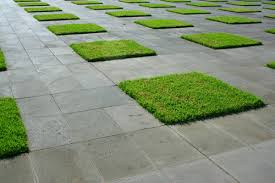
I get the upside, I just thought I’d mention the downside. After all, once concrete is laid-down, it is rarely ever removed. Under the nearly bankrupt city of Detroit are thousands of acres of what was once pristine farmland that will never see the light of day again – even if everybody left. I guess that’s true for just about every urban landscape.
Do your part for the environment – Run on grass. Preferably barefoot.
 Paleo-opolis