
Corn is a recent addition to the Human food chain. It started as a much smaller grain in Mesoamerica where it was milled as early as (but still only) 7,000 years ago.
It helped fuel the population expansion of various South American tribes, but just as with wheat, it took a lot of corn to get any real nutrition.
When corn (maize) made its way up to the southern Mississippi River Indian tribes about 2,000 years ago, they quickly learned that to avoid malnutrition, the ears needed to be soaked in alkali water (made with ashes and lime) to release the niacin that was bound-up in it. Missing this step of the process resulted in a protein deficiency known as pellagra, which became a common malady in the south through the 1800’s.
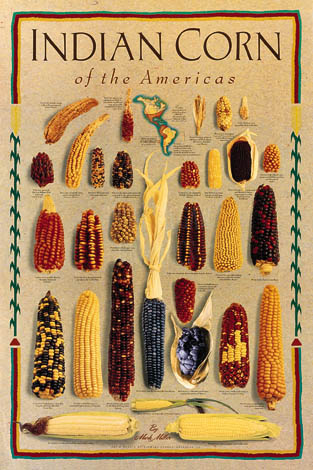
Over the centuries, corn has been bred to produce larger, and larger cobs, now culminating a huge ear almost eight inches long. Genetically Modified crops were introduced in the late 1990’s, and by 2010 almost 86% of the US and Canadian corn crops were GMO. In most cases, the Genetic altering was specifically to allow the plant to become herbicide-resistant – so that the plant could be sprayed, repeatedly, without any damage to the plant – just killing the weeds around it.
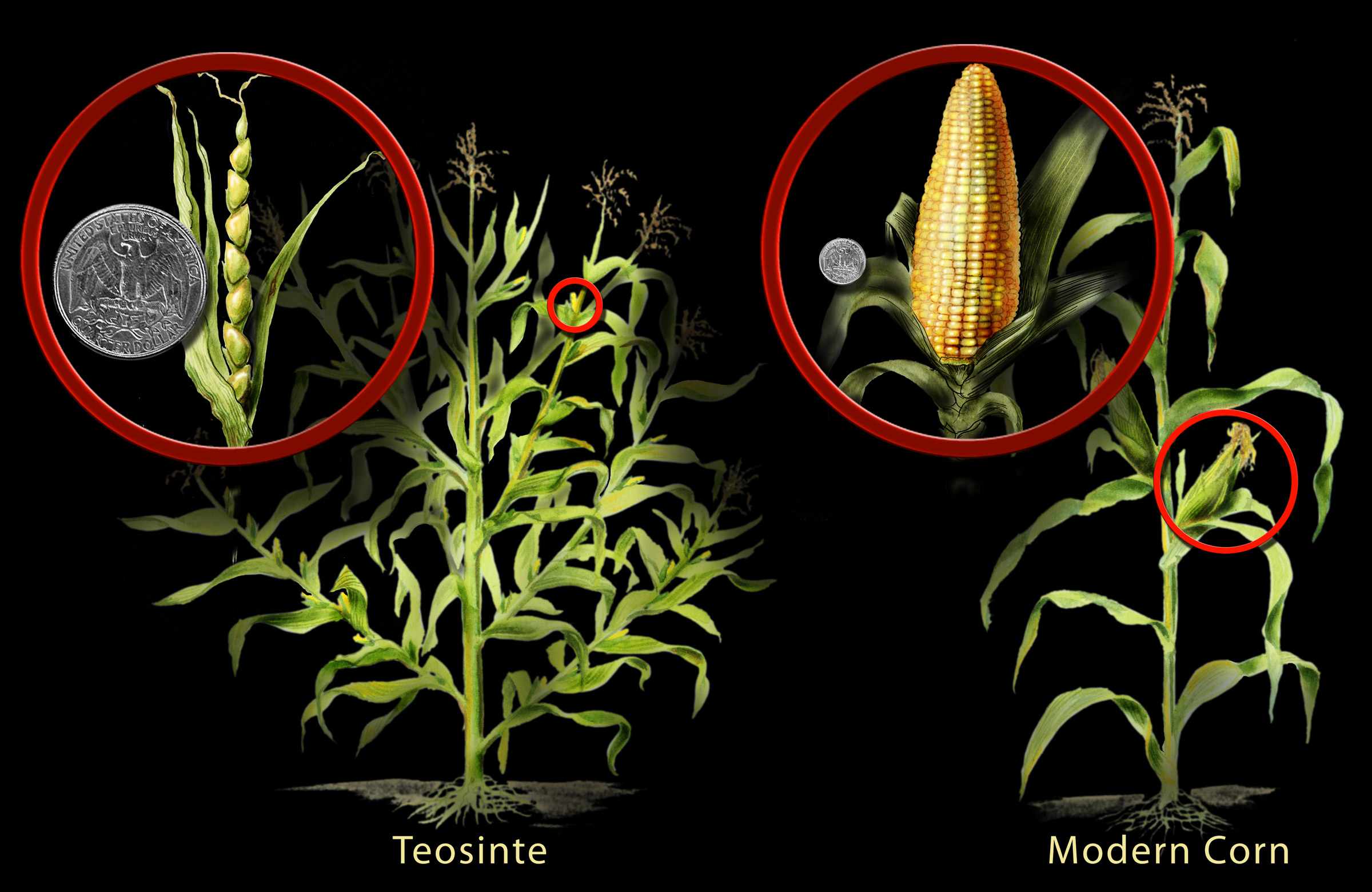
So, even with the huge ears and kernels that have been “enhanced” over the last few years, here is the nutritional break-down of corn versus 2 other common raw grains (per 100 grams):
Corn Wheat Rice
Water 76 grams 11 grams 12 grams
Carbohydrates 19 “ 71 “ 80 “
Protein 03 “ 13 “ 07 “
Fiber 02 “ 05 “ 01 “
The ratios of Sugar (carbohydrates) to Protein for these grains are:
Corn – 6 grams of sugar for every 1 gram of protein; Wheat – 5.5 grams of sugar to 1 of protein; and the worst of the grains, Rice – a ratio of 11.5 to 1. Since my research shows that sugar is not a good, or necessary, part of nutrition (see my blog on the Low Carb Diet) – that seems to be a lot of sugar for such little amounts of protein in return (Unless it’s all you’ve got).
In 2008 the 12.1 billion bushels of corn grown in the USA were sold as follows: 44% was used as livestock feed to FATTEN them up. 31% went to ethanol production because sugar can be distilled to a fuel additive, 15% was exported, 7% was turned into starch, corn oil, and sweeteners, and finally 3% was sold as food, corn meal, and alcohol.
As you can see, corn production and sales, are not about food or nutrition, they are about Sugar – sugar refined into various uses, but sugar none the less.
Almost every single type of corn grown in the world today is licensed to one corporation, and none of that corn has the ability to reproduce on its own. Farmers must repurchased new seeds every year. Also, this corn only reacts well with certain fertilizers and pesticides that are manufactured… by that same corporation.
That very same corporation also owns the patents on almost every type of soy crop grown. The same with tomatoes, beets …. It is the stated policy of that corporation to ‘Feed the World”.
We might not like to think so, but our food has become a product grown and controlled by a few large corporations, mainly Monsanto and Archer Midland Daniels.
***
About forty years ago Monsanto spliced the gene of a Halibut (fish) into a tomato. Their reasoning being that the tomato might become resistant to freezing because, after all, the Halibut is a cold water fish that can tolerate extremely low temperatures. And, Eureka! The tomatoes didn’t freeze. But they also had no taste (along with mushiness, etc.), and after a few generations they were eventually pulled from the shelves by FARMER demand – Not the FDA.
It might have worked, if each single gene controlled only one single action. But, we now know that single genes may actually control dozens of different responses in the body. A gene might be likened to a light switch that turns things on and off. Monsanto assumed one light per switch; Research now shows that each switch might be related to dozens of bulbs. Also, we have recently become aware that the strands of DNA that were once thought redundant and ‘dormant’, are actually full of switches that relevant to body growth and maintenance. Because of this, I am not a fan of Genetically Modified Foods.
***
Corn is new to cows also. Their stomachs have not had the time to evolve the ability to digest it properly, so the sugars fatten up the cattle – which is what the farmers want. In the Omnivore’s Dilemma, Michael Pollan describes the difficulties cows have trying to live on corn they can’t digest – a corn fed cow can only live about 2 years, so farmers don’t start the diet change until they are almost ready to be sold to processing companies.
One of the reasons bison meat remains leaner is because it’s much harder to get them to eat corn. Pigs, on the other hand…
***
The inventors of Kellogg breakfast cereals, W.K. Kellogg and his brother Dr. John H. Kellogg, accidentally flaked wheat berry in 1898. Then, they kept experimenting until they perfected flaked corn a few years later. In 1906 they opened their first breakfast cereal company. The brother who as a Doctor, left the business soon after – One of the reasons being that he realized a rather large amount of sugar still had to be added to corn flakes to make them palatable.
If you have a handful of corn, and a handful of “candy corn”, the candy-corn hand is holding 100% sugar (Not so oddly, corn syrup), the the real corn kernels in the other hand are “just” mostly sugar.
***
Here in Colorado, there is A GMO labeling proposal on the 2014 ballot. Monsanto is heavily vested in the advertising, and the outcome. One of their main arguments is actually quite interesting. The argument, in which Sugar Beets are an example, goes like this:
- Sugar Beets seeds are genetically altered so that, as the plant grows, it is immune to the effects of the Monsanto herbicide called – Roundup.
- As the plant grows it can be, and is, sprayed repeatedly to kill any, and all, pests.
- When the beets are harvested, they are processed and refined right down to the sugar granules.
- The sugar grains, themselves, contain no part of the original GMO plant.
- They think the sugar, which they export, should not be labeled as GMO.
- I think they might be correct.
But, here’s my problem. What Monsanto does, not as its intent, is allow huge acreages of land to be repeatedly sprayed with pesticides, herbicides, and whatever. It must have an eventual effect in the soil itself, and the run-off of polluted water from the properties must be immense. I’d like the label to reflect that.
And sadly for me, as an anti-sugar crusader, almost all the crops that Monsanto controls the seeds to, and sprays regularly, are “sugar” related crops. Corn, beets, wheat, and I don’t know what to think about Soy. But they definitely control Soy.
I wish more farming acreage in the US was planted for the vegetable crops that actually provide real vitamins and nutrients without being “modified”. Imagine farmlands covered with carrots, broccoli, lettuce, spinach, and other healthy, low sugar-“hit” types of produce. They would cost less, they take a lot less water to raise (sugar crops seem to be water needy), and the food industry might produce, and sell, less sugar. Win, Win!
 Paleo-opolis