
The starting point for any plan to “be healthier” or to “work out more” means very little if you never see progress. Old habits are always stronger than new ones unless the new ones actually do something tangible. The hardest habit to break is the one of adding weight.
It is much easier to take weight off, if you are not continually putting it on.
Diet is the key to weight, and understanding the basics is easy. First, protein, fat (nuts and natural fats), and vegetables are the bedrock of Human dietary, and physical evolution. Sugars (in amounts of any consequence) have always been seasonal, and occasional – fruits, berries, and honey were not year-round choices until commercial airline flights became routine in the last sixty years or so.
Humans, like all animals, create their own blood-sugar and always have. We have evolved a small pancreas to deal with the excess sugar that nature occasionally provides, and that pancreas tries to turn all the “excess” sugar into fat that it can store and get to later (think hibernating bear – because it is about the only other mammal that pursues sugar like we do – but the bear only fattens in the fall).
I have mentioned it before (see Low Carb Diet), and I will continue to state: There are no essential sugars. They are ALL extra. And, unless you are a super-athlete, you will never tap into the fat reserves that sugar will continue to build-up for you. If you are serious to be about improvement, rather than just trying to stay “even”, you must first make a real attempt to lower your sugar intake. For most people, that will harder than any workout.
That being said, there is improvement to be had above and beyond “just being healthy” – which a good diet alone can bring. There is being “fit”, there is being competitive, and there is the feeling of being “Aware” – Fully healthy, and ready for anything. Ready to run, play, compete, and enjoy any athletic endeavor you can imagine, within reason.
***
Free-weights and exercise machines are a recent invention. The closest things to free-weights, prior to bar-bells, were rocks and tree limbs – but rocks and trees were never about fitness, they were about food, and survival. Consequently, all of the Human muscle groups evolved with those same two things in mind.
Life for Steppen’s’ tribe (10,000 years ago) was probably much like that of the early American Indian, or any other tribe of hunters and gatherers. They walked and ran, they chopped down trees and built small structures, and they lifted and carried things, pushed and pulled things, and used their hands and arms for tearing and shredding the hides and parts of their prey. It was certainly not full-time, but it was definitely constant. They had no horses to aid in their labor, if they had seen one, they would have eaten it. Their life was full of sporadic repetitive action for the arms and legs – separated by long periods of time spent waiting. Waiting for food to be found, waiting for the weather to change, waiting for that wound to heal, and waiting for scouts to report back where they would move to next.
When the waiting was over, they were ready. Just like every other animal – without a training routine, or a special diet, or stretching – they were ready to react with lightning speed at the slightest hint of alarm, or the need to end a chase.
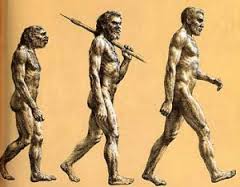
So from millions of years of routine, came the evolution of the perfect physique to perform those tasks – that perfect physique is your body. And notice, regardless of the short, or long-term heritage of your particular DNA, all of the bodies around you look like Human bodies, they all have similar form, and are reasonably matched in speed and strength. All of their muscles are in the same place and in pretty much the same proportion – no matter what the natural food or habitat of their ancestors might have been.
My point being that, at that time, almost everyone was a ‘fit’ Human being just to survive, some were just “fitter”.
And that’s what we too, are after here – fitness. And even though it has always been a basic part of our survival, we now need to pursue it without a fight to the death.
Just look at the wild horses from the plains of the west. Their musculature is every bit as developed as the most beautiful race horse you can see on the track. Their physique, like ours, is a natural development of life and survival. They run, they play, (they do not climb or lift unnatural weights), they fight each other for social position, and yet most of the time they just graze on natural grasses.
Look at the herds of beasts shown on television as they migrate across the plains of Africa – chasing beasts, or being chased – they are not obese, their muscles stand out as they run; most weight-lifters would give anything for that kind of muscle definition. Yet none of those animals are lifting weights in their free time. None of those animals are out on training runs. None of those animals are stretching as they see danger approach.
The body of a Great Dane or a Greyhound is maintained by “just doing what it is supposed to do”. It does not require much more than the proper diet, and a little drive to get ‘primal’ on occasion.
***
So, what type of work-out routine does this line of reasoning lead us to? (With an understanding that our view of “survival” in 2014 is quite different than Steppen’s)
Nothing begins without balance. Not just balance between muscle groups, but a sense of balance on your feet. Kind of like the sense of balance a child learns when he begins to walk, and then gets blown by a wind. The feeling of the muscles and bones of the feet holding your body upright while, at the same time, feeling the coolness of the floor, or the soft, warm, un-evenness of the texture on the carpet. Your feet are the key to feeling balanced. 3 Million years of evolution have been put into the mass of nerves, muscles, and bones of your feet. To be balanced, they MUST have some sense of feeling ‘solid’ ground. Imagine, for a moment, walking around in “Lady Gaga” shoes – a foot or so off of the ground. We ALL see that as being far less stable than being bare-footed. Imagine being in 6-inch heels – are they that much more stable than the ‘platform’ shoes? Let’s go down to – let’s say, a 2 inch platform running shoes. Would you run a jig-zag pattern in them? – Probably not, because most people see the inherent risk of twisting an ankle as your legs and body try to adjust for the higher center-of-gravity. For me, this leads me to the conclusion that a flat heel is best (see my blog on shoes).
Stability also comes from confidence in your body to react to outside influences. You would like to know that if you turn left quickly while walking, you won’t fall over or twist your ankle. You want to know that if you jump over a puddle, that you will land solidly. We all need a solid base and starting point, Stability is the foundation of that feeling. It can’t be done with 2-inch heels on, it can’t be done with your feet wrapped in gel.
If being barefoot is the first part of re-gaining stability, then walking is the second part. The goal is to walk until you feel comfortable. Sadly, bare feet are never comfortable on concrete, so walk in the grass or on the carpet, or wherever… until your foot muscles re-tighten (from use), and your stride shortens back up to where it should be. Until you have a few miles under your belt, there is a tendency to strike your heel a bit harder that you are used to. The reason being that your heel is no longer cushioned by an inch of foam rubber, and also, because of that cushioned heel, you tend to take too long of a stride. It may take days, it may take weeks, but you begin to notice how ‘un-stable’ regular, over-padded, shoes feel. I’ll say it again, avoid concrete. Your foot muscles will tighten-up, your arches will follow, and your ankles will thank you.
***
The next level of fitness would be that of recovery. For many, the ultimate test of an athlete is how quickly his heartbeat returns to ‘normal’ after a taxing endeavor – how much time passes before he can do “whatever it is” again. It is a test of heart strength and muscle resiliency. It is the test of a wrestler, a boxer, a bike racer, a football player…a wolf in pursuit of prey. Endurance and stamina are different beasts, but they will be able to build as balance improves and recovery times decrease.
In the world of Steppen, most athletic events were fairly quick and intense. The plains of Africa may have provided the terrain for long, long runs, there are no animals that are going to chase you for more than a few minutes. Steppen couldn’t have carried enough water to stay hydrated for marathon distances, and he would not have wanted to run any risk of injury brought on by fatigue. Steppen was smart with his energy output because he knew that he had to personally ‘feed the furnace’ of his engine, and his ‘engine’ had to personally feed him. Stamina and endurance are the ability to go a little farther if you have to – the ability to get up tomorrow, and do the same ‘hard’ thing again if need be. Their combination becomes the capacity to endure – to know that being tired at the end of today, does not mean that you’re not fully ready for tomorrow. You and your body can be as tireless as the beaver if you need to be – stamina is NOT seeing how many trees the beaver can chew down at one sitting, stamina is building the DAM.
To that end, how does one build recovery and stamina? My answer is to do the activity you wish to conquer, often, and with intensity – but not too much. Over-training can bring as many ills as training badly. All ailments require recovery. Many, many world records have been set after an athlete has been forced to sit out for a few weeks so that an injury could fully heal. And while the injury was healing, the body was also finally getting a chance to fully recover form never ending practice and training).
Short and intense, that is the type of activity that built the Human body. Short and Intense, repetitively, builds stamina and recovery.
For full-body strength, the work-out is simple:
For a few years, I took the following “attitude” into my workout: First, I would run a little – under 2 miles – slow at first, then mix in a few sprints of 20 yards or so.
Then I would head to the machines and do some seated (or standing), presses and pulls. Followed by some chin-ups and dips. The time in the gym, and on the machines, would generally take less than 15 minutes, and consisted of: 8-10 slow reps at a light weight, 6-8 reps at a medium weight, and a final 2-4 reps at a weight I could barely move – I would do the machine part twice, not the run. The cool-down consists of going home and eating something with proteins and fats, no sugar.
The rationale being: I chased the beast, I fought the beast, and then I ate it (no beast contains sugar).
You probably wouldn’t get the opportunity to fight a beast every day, so I didn’t pretend to. Some days I’d climb a tree or do something else entirely different. Some days you chase the bear, Some days you just try to get around him.
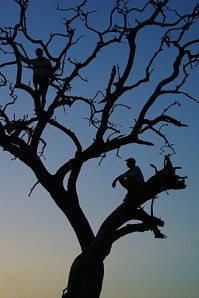
If you’re not up for that level of activity, and just want to be toned, then everything is easier. Just walk, run, push, and push or pull things when possible. Lifting things up and pushing them down may not seem like major types of tasks, but we have evolved some pretty major muscle groups to help us carry out tasks that require pulling things from the ground, or pushing objects(or people) away. The muscles involved in pulling things toward us are fairly major also. Maybe do some push-ups, or chin-ups on occasion.
Sit-ups are not really required for “killer abs”. For most people, when the stomach fat is finally gone, abs are what is left. They are a natural muscle group – they are just the first muscle group to get covered over by fat – and the last to be un-covered.
***
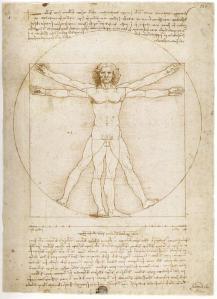
If, after you see how your body looks as “normal”, you decide you want some part of you to be bigger, which is a personal issue, not a health one. Go see a trainer, or carry around big rocks, but please don’t do any motions, with a heavy weight, that are not a natural motion of the body, including lifting very heavy objects over your head (spinal compression comes to mind). These things are unnecessary, and raise your probability of injury.
Also, those people who have trained towards greater muscle mass, and then for whatever reason have had to reduce or stop their training, tend to gain weight – not from muscle turning to fat, because that doesn’t happen, but because their eating habits didn’t reflect the same level of cut-back. Big muscles are expensive to feed, and the dietary habits that are necessary to keep them, are very hard to kick. They are usually as much a part of the cost and time, as the actual work-out – but without the extra bulk to feed, they find other places to go.
The bottom line? Climb trees, run barefoot with your dog, carry your groceries farther, play tug-of-war with a friend, use your hands to manipulate something, try to pull old rags apart, try to hold things together.
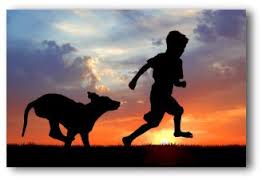
Impress people with your agility, and lightness on your feet, not the presence of your mass – as impressive as it may be. One is far more socially interactive.
 Paleo-opolis