
There are 206 bones in the body, and over half of them (106) are found in your hands and feet! The hands have 27 bones each, and the feet 26 (the difference being that the ankle has one less bone than the wrist). The supporting nerves, muscles, tendons, and ligaments for both, are also in extremely high proportion to the rest of the body.
Evolution has invested a large percentage of our physical, and informational resources into our hands and feet. And, one might think that the “Body” expects to get a large amount of movement, motion, and input in return. They are the physical ‘tools’ your body uses to run, to climb trees, to perform tasks, and to build new things. It is through them that the body can manipulate objects and move itself about. They can also feel all degrees of hot and cold, wet and dry, and comfort and pain. They are an astounding bit of physiology.
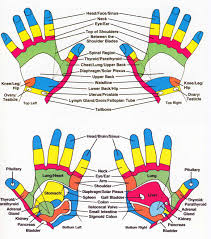
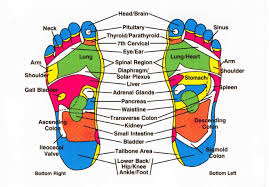
Having said that – A huge proportion of our western culture never lets their feet touch solid ground. Shoes, Slippers, sandals, flip-flops, high-heels, boots, socks, inserts, plush-carpets, pads, etc…. How much of any given day are your feet “un-wrapped” and actually touching a stable, flat surface? You certainly wouldn’t wear gloves an equal proportion of the day (unless it was really cold!). What is it about our feet? – I get the impression that many people just don’t like the thought of them touching anything, or anything touching them!
The shielding of our feet from the unkind terrain is nothing new. The shielding of them from all terrain is fairly recent. Rubber, attached to the bottom of shoes, has brought a major transformation to walking, running, and just standing still.
But, the basis for this blog is to ponder Steppen using modern technology and see if there are areas for potential conflict with his physique, so:
Being Hunter-Gatherers, Steppen’s clan walked anywhere from hundreds to thousands of miles a year. Evolution worked with that – even a callused foot can be still be tickled.
Steppen usually ran barefoot, but occasionally he would lace a thin leather pad to the bottoms of his feet if he thought he might be traveling on sharp terrain. The ‘shoes’ that Steppen, and similarly, the natives of North America, wore did not absorb shock. They were flat leather; either thick for protection, or thin for adornment, well dressed and cured (smoked) to prevent hardening, but they had no raised heel or rubber padding. Much like a women’s “flat” or short-track running shoe without the cleats.
His runs were on narrow tree-lined paths with limited sight ahead or behind. The paths were relatively short, connecting nearby villages to each other and the river, mostly under a mile. Even the chases for food, and from predators were reasonably short due to the undulating and heavily-treed terrain. Whether you got ‘it’, or ‘it’ got you, the chase was short either way, usually under a minute – definitely under five. And I’m thinking a lot of zigs, and zags.
Steppen, and his neighbors, were not ‘Marathoners’, nor would they ever be – maybe they were continuing to evolve a slightly different leg muscle tissue mix (fast/slow twitch fibers) than their ancestors who came from wide, open spaces. The basic thought being that everything, man or beast, must be able to flee – or it becomes something else’s meal. The terrain you live in, as a group, over thousands of generations, dictates the tools that evolution has to work with. The evolution of legs in meadows, rivers, and forests for thirty thousand years does not produce the same results as it would in wide open plains.
So what are the variables the running shoes bring in?
1) His stride – When Steppen ran, his stride was fairly short, and he ran on the balls of his feet. The reason being that the body doesn’t like to come down hard on its heels if it can help it. His toes were involved, his arch was involved, his ankle is involved, – but his heel… not so much. When he ran, his speed was quick because he took more, and faster, steps.
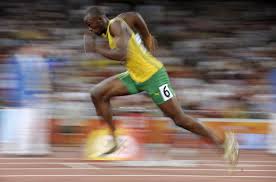
Running shoes would have lengthened his stride considerably, and because the rear of the shoe is so flared and cushioned his heel would now tend to become part of the stride.
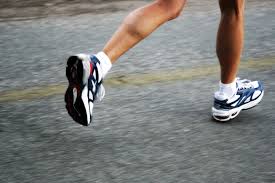
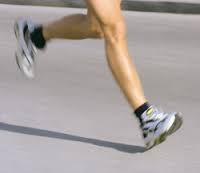
2) The first time he turned quickly while at a hard run, he would notice his slightly higher center of gravity, the softness of the shoe, and the wide, textured sole allows his ankle to twist a little further than maybe it “should”. But he had pretty strong ankles, probably stronger than yours.
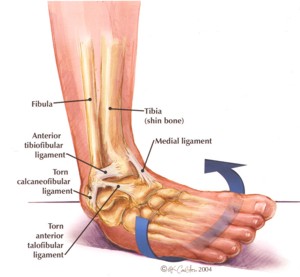
Steppen’s first ‘runners injury’ would have probably have been his last. Remember, the things that couldn’t run, became food.
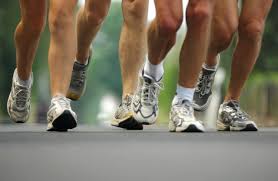
3) Contact with the ground – The cushioned soles of the running shoes absorb quite a bit of energy, the heels are designed to be even softer. When a runner’s foot strikes the ground, with the full momentum of the impact on his heel, that energy goes somewhere. Research shows that a lot of it travels up the tendons, the leg bones, the joints, and for heavy runners, all the way to the hips. Many people rotate up to the balls of their feet as their speed increases, regardless of the shoe design – and that is the best way to minimize the impact. But, many more never do. And generally, as the distance increases, most runners end up with their shoes landing flat, or towards their heels.
My perspective is this:
I understand that you can design an egg container that can be dropped from almost any height while leaving the shell unbroken. But I believe that the yoke is usually damaged – my view is that your soft parts (joints, tendons…), all the way up your leg, are akin to the yoke. The eggshell represents your skin, and there is no damage to be seen, so you keep running. It’s not like every step is akin to a leap from a tall building, but the comfort of the shoes allows you to “smack” the ground (usually concrete) so many, many more times.
So where does that leave us?
Wearing shoes has become the “norm”, and they are often necessary – Who wants to walk barefoot on a filthy, city, sidewalk? And, who would want to run on concrete barefoot?
Personally, I shifted to ‘barefoot shoes’ years ago and have never looked back (the recent lawsuit had nothing to do with the barefoot theory – which is still sound. The suit had to do with the marketing of the theory)( I still love my Five-Fingers). I finally made the move when I noticed that all of my dress shoes had a worn heel –because the unnoticed striking of my heels was wearing them down (the habit is so common, it developed its own term – scuffing). I began to wonder, “Why did all of my shoes have built up heels?” Does everybody have a need to be taller? I could never find a reasonable reason for heels.
Now, I feel more comfortable walking and running without a thick sole between my feet and the ground. And, I feel more like running, more often. If I’m not wearing bare-foot shoes, I’m barefoot. For the winters here in Denver, I have some barefoot-style Merrill’s that allow me to wear socks. Certainly there are formal events that require other foot-wear, but truly, it is never by preference anymore. And, since I mainly do short sprints when I run, finding places without concrete is fairly easy.
Another way of thinking about padded feet: If you are standing on a soft rubber platform (think inserts or foam rubber balls, marshmallows, it makes no difference) your body is constantly having to adjust its balance to keep you from falling over. If you are standing barefoot on a hard, flat, surface, your body is not adjusting anything – it is at rest (as much as it can be while standing). So, the softer your shoes, the more your joints and hips have to work to keep you upright – because, however little it might be, you are not stable. Heavy people and old people come to mind as those who have the most to gain from being on solid ground.
The important thing, is to remove your shoes when they are not needed – like around the house, around the yard, around the park. Concrete, however, is NOT a natural surface.
I’m not sure that high-heels need any real discussion, in this context.
***
I highly recommend reading a book titled Born To Run by Christopher McDougal (vintage Books 2009
Oh, and if you find that all of this new exposure for your feel is leaving you with rough or dry soles, rub in a little Vaseline at night or in the morning. Petroleum jelly is probably a base ingredient for most of the other lotions anyway – and everything works better if you try to stay on the ‘preventative’ side of the issue, versus the “curative/recovery” side.
***
The argument of “shod” versus “unshod” also continues into the area of Horses. It seems that Jumping Competition rules require that horses be shod (horse-shoes) to compete. One horse trainer has been trying for years to inform the horse industry of the benefits to the horses when they remain unhindered by metal “shoes”. The argument there, like mine above, is also about balance, “feel of the earth”, center of gravity – and, of course, millions of years of evolution without shoes.
The shoes were originally designed as protection for horses, since they were being made to run and work on rocky, or man-made concrete surfaces. Those are things they would probably not do willingly on their own (any more than humans would, but it sounds familiar) – but, there are no hard surfaces nowadays in Jumping! Or track racing for that matter – just nice soft dirt.
I understand the need for horse-shoes when a horse will be forced to walk or run on a surface that would injure his feet, it would be no different for humans. City police-horses – yep. Trail horses in the mountains – yep. I’m trying to think of more…
 Paleo-opolis