There has been a recent adjustment to Steppen’s appearance, and to some of our genetic history.
In my original introduction, I stated that Steppen would look like everybody else at a modern bus stop. New DNA evidence has changed that view – with an interesting twist.
Most of the evidence to date had suggested that blue-eyes and fair skin were beginning to make their debut in Northern Europe a little earlier than, or concurrent with Steppen about 10,000 years ago – mainly due to less light at the higher latitudes. So, I had imagined Steppen with those same light features, however…

Prof. David Reich from the Harvard Medical School has just published a study of the genomes of seven hunter-gatherers from Scandinavia, another from Luxembourg, and an early farmer from Stuttgart, Germany (BBC News 9/17/14).
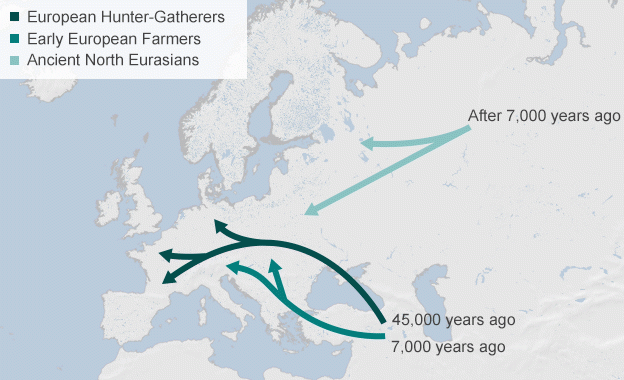
From this very thorough research, and a few other recent studies, a new picture of “Modern Man” has emerged. It shows him to be a blend of three different cultures that came into contact with each other over a period spanning about 4,000 to 7,000 years ago.
First, about 7,000 years ago, there was the ‘genetic mixing’ of North European Hunter-gatherers, with farmers who had started migrating north from the Fertile Crescent area. Climate conditions in Europe had steadily improved since the last glaciers receded, and the farmers (which includes herders as well as those who planted crops) followed.
The research suggests that the modern European gene pool was then finalized within the last 4,000 – 7,000 years as “Hunting-Farmers” intermingled with an ancestrally related group of H-G’s that had headed for Siberia shortly after the original migration out of Africa 60,000 years ago. Some members of this same Siberian group had headed even further east a little earlier, and became the first Humans in the Americas about 15 – 20,000 years ago. Many of the remaining clan members who had stayed in Siberia, ended up migrating back to Europe, and that last dash of DNA was just enough to give the citizens of Northern Europe the “modern” genetic make-up that still exists today.
Here’s the surprise – The DNA of the original hunter-gatherers (including Steppen) shows that they were dark-skinned and blue-eyed (the report used the term “swarthy”). A surprise, since they were expected to be fair skinned. This was followed by the surprise that the farmers were the pale ones – And that their genomes were the ones that most matched that of Modern Man.

Prof. Reich says that Steppen would have definitely stood out at the bus stop, because the combination of his eye-color and skin-tone no longer exist, his appearance was striking. Wheat (and other grains) came with the farmers and arrived much earlier than I originally thought, certainly pre-Roman.
And whereas the theory remains that the evolution of skin color is a function of the amount of sunlight received (hence the amount of vitamin D received) – here is the surprising new twist to that theory:
Hunters and gatherers got enough vitamin D through their food (sunlight or not) – because the animals they ate had a lot of it – so, oddly, their skin coloring had still not changed much since the original African migration. Farmers don’t get as much vitamin D (since they were not eating as much meat), so they are the ones that needed the extra vitamin D. They evolved pale skin to absorb it.
The Blue-eyes still seem to fit within the original theories.
So, it is within this new adjusted frame-work that Steppen lived. And his genes are still in me, but I now see a larger blend, over time, from the farmers of the south. But remember, we are talking about appearance, not basic anatomy. If there was an anatomical variance, it was, and remains, the different gut bacteria strains that inhabited the intestines of each group.
I will still hold that Steppen’s anatomy, physical and digestive, are relevant in my comparisons. But I will certainly be more conscious of the earlier (by a few thousand years) influence farming has had to “our” genomes.
 Paleo-opolis