Last night my wife read the draft for my next blog, and she brought it back with a few comments.
Her first question was – “How readable, versus how technical did I want it to be?” I told her that I wanted it to be accurate, and that I wanted enough detail so that, at least some of the questions the blog might elicit, could be answered right there. I think detail is sometimes necessary for credibility. After all, I try to do quite a bit of research, and I tend to like it when numbers can put things in perspective. So, in that arena, I will hope to strike a balance, or maybe I’ll put the math in separate blogs.
Her next question was, “How did “Diet” fit into my view of “adaption vs. evolution” and the “interaction of technology and Mankind”?” That’s a valid question. In my view, farming is technology, and nothing has changed the flow and growth of Human population more than the advent of agriculture. And no one has tried to force more “adaption” upon us than the purveyors of food products.
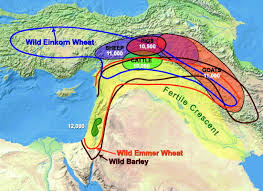
Science suggests that the first organized cultivation of wheat began in the Fertile Crescent of Mesopotamia about eight thousand years ago (2,000 years after Steppen, and a distant 2,000 miles away). A single wheat grass, on its own, is only attractive to birds and rodents. But, when hundreds are gathered, and the millions of seeds milled, it becomes a paste that became the first palatable “filler” capable of adding bulk to the basic food groups of meat and vegetables – but it did not grow everywhere. Where the climate was mild enough, around the Mediterranean Sea, it stretched the food supplies of many growing tribes that could now get by on far less wandering and gathering.
Wheat, on its own, brings very little nutrition to the table. It is about 90% starch (it is the plants way of storing excess sugar), it has less than 10% protein, and it has a very small bit of iron and vitamin B. “No man can live by bread alone”, was not just a saying. Fortified modern bread might be “enriched” enough for a little sustenance, but that’s a whole different blog. So, wheat, a very recent addition to the Human diet, becomes the first “Meat-Helper” and then works its way up to baked goods.
Wheat allowed the armies of Persia to invade Early Greece, because wheat, combined with the management of cattle, allows for unprecedented population growth – Not particularly healthy population growth, but when humans have relative safety, and a steady food source, they tend to breed early, and often. Wheat, as “meat-helper” allowed the vast numbers of workers to build the Great Pyramids. There were no fresh vegetables at the front lines – and it would be impossible to keep an army of hundreds of thousands of men fed properly with cattle alone. Wheat can even help feed the cattle.
Wheat, and then the organized farming of other grains, became a science, then a technology, and now it is an industry – with aggressive marketing tactics pushing a constant search for diversification (and infusion) of its product.
The technology of foods brought choices, and options to the dinner table. The many choices of a particular “Diet” only exist because of our technical ability to grow and move foods anywhere, at almost any time. The choice of a year-round diet of fish, or vegetables, or even juices, is very new to our gastric system – is it a matter of “attempted” adaption because we grow, not evolve, to like particular tastes.
Finally, – She took issue with my use of the term “Carbs”. She has held the belief that the word vegetable is interchangeable with the word carbohydrate. So, I must confess that it aggravates me to no end that current marketing has taken to calling all vegetables, in a general sense – “carbs”. Vegetables are not carbohydrates. Vegetables contain carbohydrates… along with vitamins, minerals, fiber, water and other good things. Carbohydrates are SUGARS, nothing more, nothing less. The words sugar and carbohydrate are interchangeable in every sense, the words vegetables and carbohydrates are not interchangeable without causing conversational confusion. In nature, sugars are biologically produced -the “simple” combination of carbon and water. Our liver produces the human carbohydrate – glucose. Plants however, can also produce fructose, sucrose, and a few others. If sugars/carbs could be combined non-biologically in nature, then it could conceivably rain sugar from the sky, or there could be sugar mines in the earth (it doesn’t, there aren’t).
Let’s call vegetables by their names, and let’s do the same for sugars, otherwise we head down the same slippery slope that marketing brought to the word “fat”. Trying to enlighten people regarding the difference between the fat in nuts, versus the fat around their bellies – and why one is good for them, and the other is bad – is a never ending “dietary” problem.
I will try to keep it interesting.
 Paleo-opolis